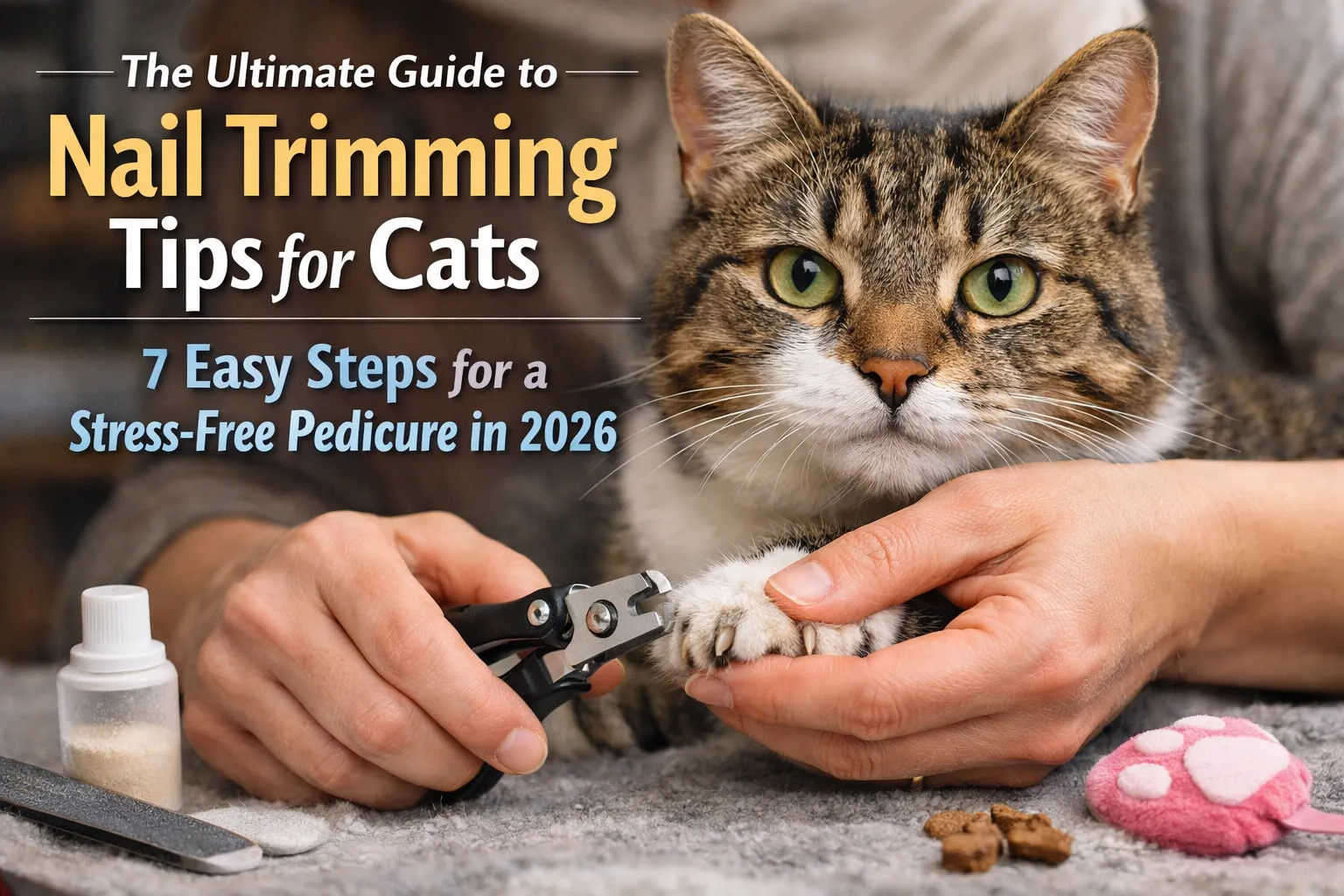
If you’re a cat person, you know the drill. You’re relaxing on the couch when your cat hops into your lap, purring away. They knead your legs and for a minute it’s bliss until those fervent, razor-sharp claws latch on, and one minute you’re oozing with love, the next you’re yelping. For most owners, the idea of cat nail trimming tips brings to mind hissing and scratching and a furry projectile launching itself under the bed. You are not the only one going through this.
nail trimming tips for cats nails is often seen as one of the most intimidating parts of pet ownership. Cats are unbelievably touchy about their paws, unlike dogs. Their claws are their main tools for defense, for hunting, and for climbing, so it’s only natural that they’d be protective. But failing to be up to this regarding grooming can result in more than scratched furniture. Overgrown nails can curl or grow into your cat’s paw pads, causing sharp pain, infection and trouble getting around especially for indoor and older cats that do not wear them down naturally.
But it doesn’t need to be a wrestling match. In 2026, we know more about feline behavior and have better tools to make this process smooth, safe and even bonding. This ultimate guide details the tips and tricks to polishing your pedicure with ease. So we gathered the best advice, approved by veterinary professionals, as well as simple techniques to get you from anxiety-ridden to pro. Whether your cat is a wiggly kitten or a grumpy old man, these simple tips will save your furniture, skin and cat’s health.
In this complete guide, you’ll discover:
- Why regular trims are non-negotiable for your cat’s health.
- The top tools you need for a safe and easy trim in 2026.
- A simple, step-by-step process to cut nails without the drama.
- Pro tips on how to handle the dreaded “quick” in both light and dark nails.
- What to do if you accidentally cut the quick.
- Expert advice for dealing with the most uncooperative felines.
Why Regular Nail Trims Matter
Before we discuss the how, however, let’s consider the why. In the wild, cats keep their claws trimmed through continual activity—foraging up trees, hunting prey and navigating rocky terrain. Your indoor kitty, though, spends the majority of their time on cushy rugs and sofas. And while a good scratching post assists them in shedding outer nail sheaths, it rarely maintains nail length at an ideal level.
Regular trimming is crucial for several reasons:
- Health and Comfort: It prevents painful conditions like ingrown nails, where the claw curves back into the paw pad. This is particularly common in less active senior cats .
- Safety: Long nails are more likely to snag on carpets, fabrics, or furniture, which can injure your cat as they try to pull away .
- Protection: Shorter, blunter nails mean less damage to your furniture, curtains, and, most importantly, your skin during playtime.
- Bonding: When done correctly, grooming sessions can strengthen the trust between you and your cat.
How Often Should You Trim?
The frequency is dependent on your cat’s lifestyle. Indoor cats usually require a trim every 2 to 4 weeks. Outdoor cats may require less padding (once every 4 to 6 weeks) if they are active, but always look for overgrowth or injuries. If you hear your cat’s nails clicking on hard floors, it’s time for a trim.
Gathering Your Arsenal: The Best Tools for the Job
Adopting the appropriate tools is half the battle. Do not use human nail clippers, which can smash a nail instead of cutting it cleanly and cause splitting and pain. Here’s what you need for a fruitful trim in 2026.
Choosing the Right Clippers
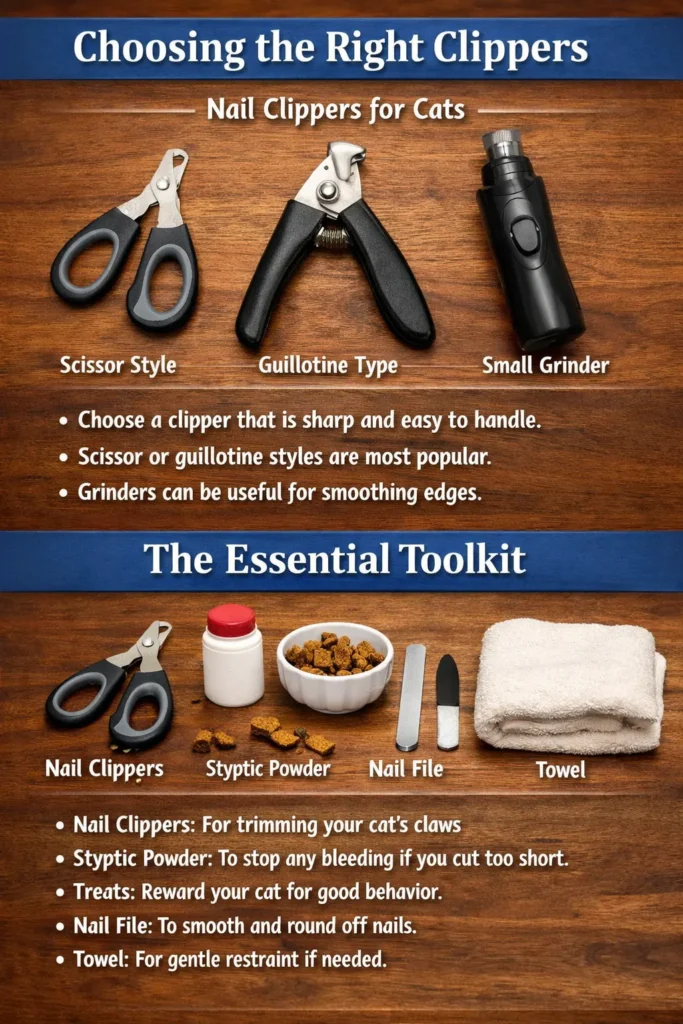
There are three main types of cat nail clippers, each with its pros and cons :
| Clipper Type | Description | Best For |
|---|---|---|
| Scissor-Style | These look like small scissors with curved blades that fit around the nail. | Beginners and precision. They offer great visibility and control. |
| Guillotine-Style | You insert the nail into a small hole, and a sliding blade cuts across it. | Thicker nails. The blade stays sharp longer but can be trickier to master. |
| Pliers-Style | Similar to scissors but with a spring-loaded action for extra power. | Tough, sturdy nails. Requires a steady hand due to the extra force. |
| Nail Grinder | An electric tool that files the nail down instead of cutting it. | Cats afraid of clippers. It’s quiet and reduces the risk of cutting the quick, but the vibration can take getting used to . |
The Essential Toolkit
Beyond the clippers, having these items on hand will set you up for success:
- Styptic Powder or Cornstarch: This is non-negotiable. If you accidentally cut the quick (the pink area containing nerves and blood vessels), this powder stops the bleeding instantly .
- High-Value Treats: Forget their regular kibble. You need something irresistible, like small pieces of cooked chicken, tuna, or commercial lickable treats .
- A Comfortable Towel or Blanket: For the “cat burrito” method, which helps restrain anxious cats gently and securely .
- A Flashlight: This is a game-changer for cats with dark nails. Shining a light from underneath can help you locate the quick .
Step-by-Step: How to Trim Your Cat’s Nails
Patience is your most important tool. Rushing this process is the number one reason for failure. Follow these steps to create a calm and positive experience.
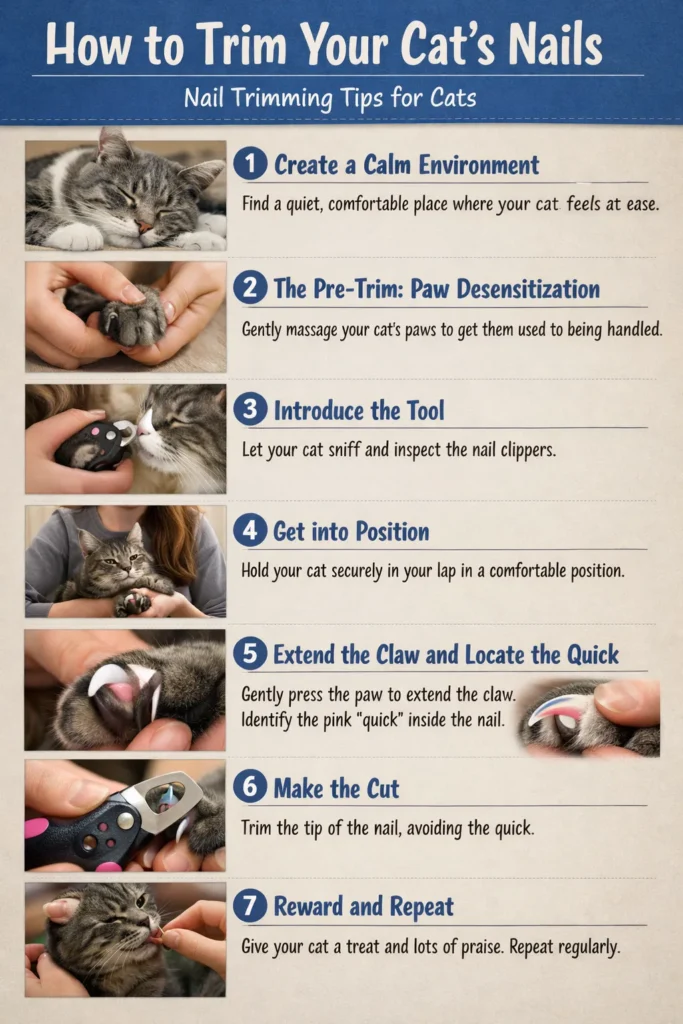
Step 1: Create a Calm Environment
Pick one quiet room with no other pets or loud distractions. Choose a moment when your cat is already at ease — typically after a meal or a good snooze. Before starting, do several deep breaths. Cats are very intuitive and they will sense your stress, which will only make them anxious.
Step 2: The Pre-Trim: Paw Desensitization
If your cat is not accustomed to having their paws handled, don’t even bring the clippers out yet. For a few days, before your first real go at it, spend a couple of minutes rubbing their legs and paws. Gently squeeze on their toe pads to make the claws come out, then instantly offer a treat. The idea is to build a positive association: paw handling = yummy treat.
Step 3: Introduce the Tool
Let your cat inspect the clippers. Place them on the floor with a treat on top. Click them near your cat (without cutting) to let them get used to the sound .
Step 4: Get into Position
Find a position that works for both of you.
- On Your Lap: Place your cat on your lap with their back to your stomach. This is often less threatening than facing you .
- On a Table: For better access, place them on a sturdy table or counter, with one hand gently supporting them.
- The Cat Burrito: For resistant cats, gently wrap them in a towel, leaving only one paw exposed at a time .
Step 5: Extend the Claw and Locate the Quick
Gently hold their paw. Place your thumb on the top of the toe pad and your forefinger on the pad underneath, and squeeze gently. The claw will extend .
- On Light Nails: The quick is easy to spot—it’s the pinkish area inside the nail. Cut at least 2-3 mm away from it .
- On Dark Nails: This is trickier. Examine the underside of your nail Trim only the very tip, or where the nail begins to turn downward. You can also shine a flashlight behind the nail to light up the quick. When in doubt, cut less.
Step 6: Make the Cut
Position the clippers straight out from the claw and snip at a slight angle, following the natural curve of the claw. Cut with confidence and make it fast. A mindful, slow cut is less likely to pinch the nail and hurt.
Step 7: Reward and Repeat
Once you have successfully clipped one nail, treat your cat and congratulate. When your kitty stays calm, continue to the next nail. If they begin to fidget, back off. It’s totally normal to just do one paw — or even a few nails on a single paw — during a session. You can always return for more tomorrow. Close each session on a positive experience with a parting treat or play time.
Pro Tips for a Perfect Pedicure
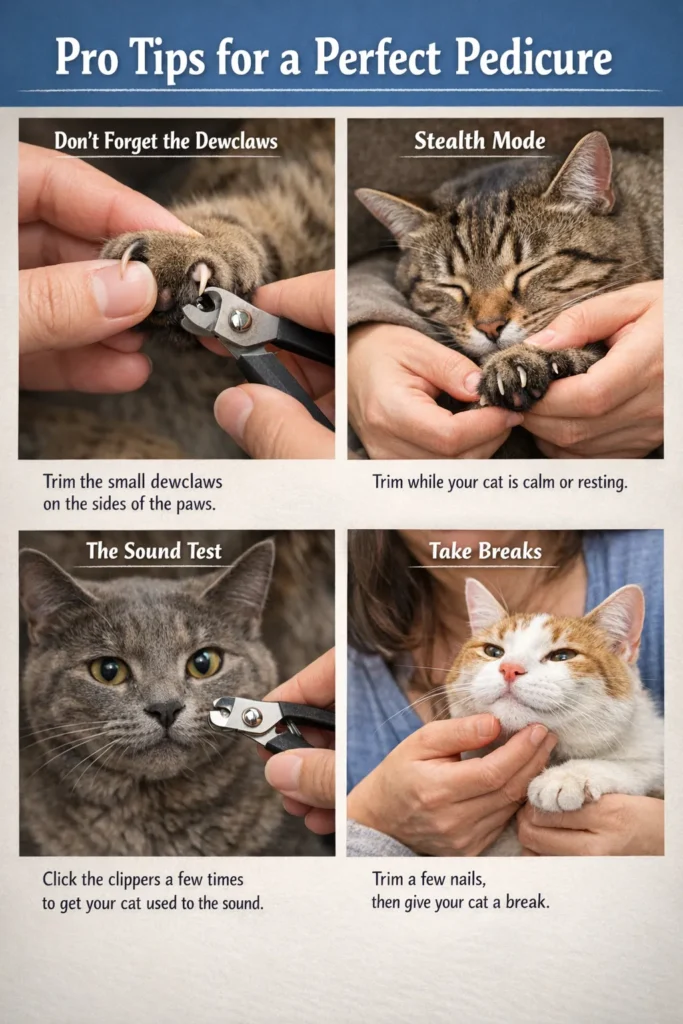
- Don’t Forget the Dewclaws: These are the “thumb” nails located higher up on the inside of the front paws. They don’t touch the ground and never wear down, so they are prone to overgrowing and curling into the leg .
- Stealth Mode: If your cat is a deep sleeper, try the “stealth trim.” Wait until they are fast asleep on your lap and gently clip a nail or two. They might wake up but won’t register what happened .
- The Sound Test: Some experts suggest practicing on a piece of dry spaghetti. Clip it with the clippers near your relaxed cat to desensitize them to the sound before you go near their paws .
- Take Breaks: If your cat is getting stressed, stop. Forcing the issue will break their trust and make future attempts exponentially harder.
Emergency Protocol: What If You Cut the Quick?
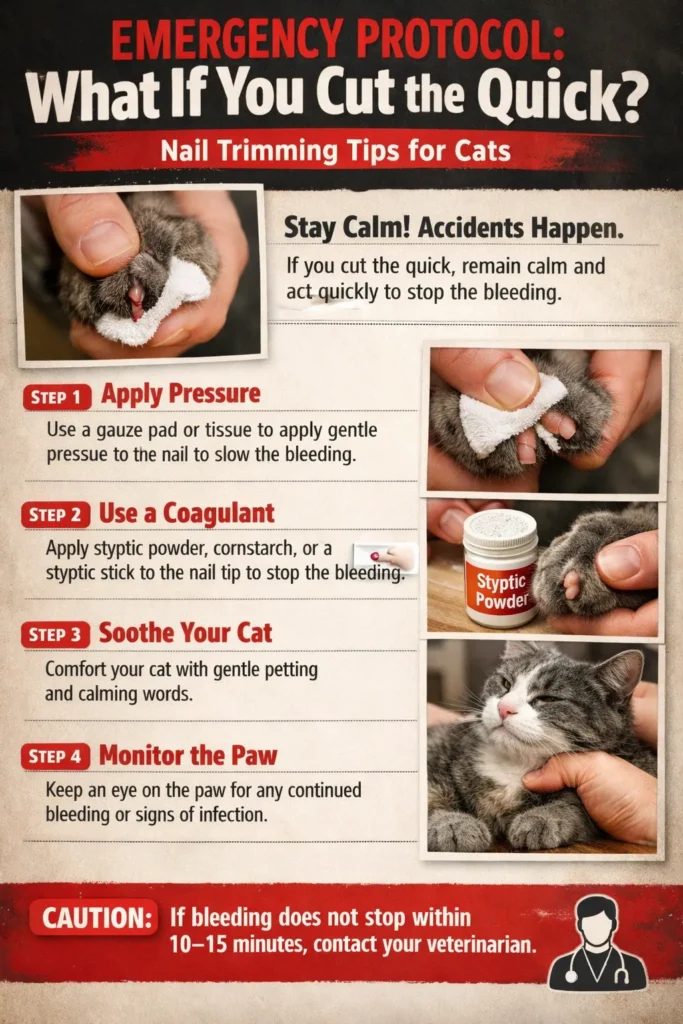
Even the most experienced groomers have accidents. If you cut the quick and see a small amount of blood:
- Stay Calm: Your cat will react to your panic. Speak in a soothing, gentle voice .
- Apply Pressure: Immediately dip the nail into your styptic powder or press a cotton ball with cornstarch onto the tip.
- Hold and Soothe: Hold gentle pressure for 30-60 seconds. The bleeding will almost always stop within two minutes .
- Stop the Session: Do not attempt to cut any more nails. Give your cat a treat and lots of praise. They will forgive you, but you need to rebuild that positive association.
How to Handle Difficult Cats
Some cats require extra patience and strategy. Here’s how to handle common challenges:
“My cat becomes aggressive when they see the clippers.”
These are the higher nails on the inside of the front paws, aka “thumb” nails. It is an easier process and the pads will stand still as they don’t touch the ground and never wear down, so can tend to overgrow and curl into the leg.
“My cat is a rescue and hates having their paws touched.”
For a heavy sleeper, try the “stealth trim.” Wait until they are fast asleep on your lap and snip a nail or two. They may show signs of waking up but do not register what has happened.
“My cat is too strong and squirmy.”
Some experts recommend the dry spaghetti test. Also make sure to clip it with the clippers close enough to your cat who is calm and relaxed, so they get adjusted to the sound before you come near their paws.
Top 5 Nail Clippers for Cats in 2026
Based on expert reviews and owner feedback, here are the top-performing tools this year.
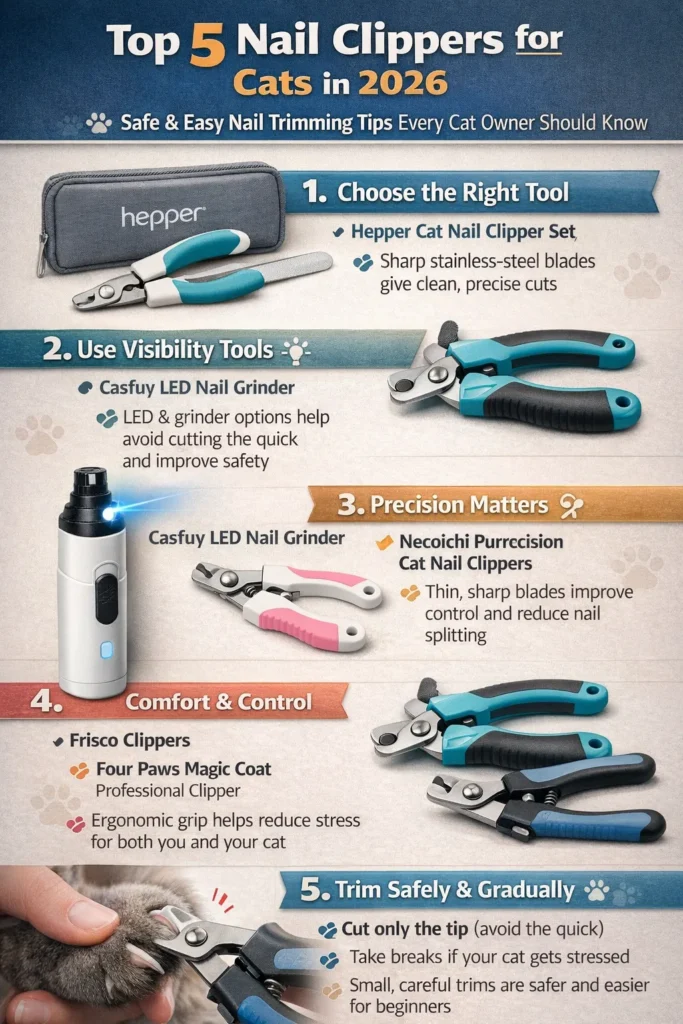
- Hepper Cat Nail Clipper Set: Voted best overall for its complete kit, which includes both large and small clippers with safety guards and a nail file. Perfect for cats of all ages .
- Frisco Dog & Cat Nail Clippers: A budget-friendly, high-quality option made with Japanese high-carbon steel. Ideal for small pets .
- Casfuy LED Nail Grinder: A top choice for electric grinders. It features two LED lights to help you see the quick and two-speed options, making it a safe alternative to clippers .
- Necoichi Purrcision Cat Nail Clippers: These clippers have a 30% thinner blade for a cleaner cut and better visibility, a favorite for owners of cats with thick nails .
- Four Paws Magic Coat Professional Cat Nail Clipper: Great for kittens and small cats, these are small, sharp, and easy to handle .
FAQ
1. Can I use human nail clippers on my cat?
It’s not recommended. Human clippers are designed for flat nails and can crush or split a cat’s curved claw, causing pain .
2. My cat absolutely hates nail trims. Are there alternatives?
Yes! If your cat fails to cope with trimming, you might consider nail caps (such as Soft Paws). They are soft vinyl caps glued over the nail that can last 4-6 weeks. They have to be trimmed before you put them on.
3. What happens if I never trim my cat’s nails?
Untrimmed nails can grow in a circle and pierce the paw pads, leading to painful infections and difficulty walking. They can also easily snag and tear .
4. Is it better to clip or grind a cat’s nails?
It depends on your cat. Clippers are easier, but you risk cutting the quick. Grinders are safer because they gradually remove material from the nail, but their noise and vibration can be frightening for some cats.
5. How do I trim a cat’s black nails?
You can’t see the quick, so trim very small slices off of the end. Look at the cut surface of the nail, and if you see a dark circle or pink dot in center we are approaching the quick you should stop.
6. Should I trim my outdoor cat’s nails?
It depends. Outdoor cats need their claws for defense and climbing. Only trim them if they are truly overgrown. If you’re unsure, ask your vet for advice .
7. At what age can I start trimming my kitten’s nails?
You can start as early as a few weeks old. The goal isn’t to actually cut long nails, but to handle their paws and mimic the process so they grow up comfortable with it .
8. My cat’s nail is split. What should I do?
If the split is small and not bleeding, you can carefully file it smooth to prevent snagging. If it’s bleeding or seems painful, consult your vet to prevent infection .
9. Why do cats retract their claws when I try to cut them?
It’s a natural defense mechanism. Gently squeezing the toe pad will usually extend the claw. If they are pulling away, it’s a sign they are anxious, and you should take a break .
10. Is it safe to sedate my cat for nail trimming?
Never use over-the-counter sedatives. If your cat has extreme anxiety, consult your vet about prescription options or professional grooming under supervision .
11. Do I need to trim the back paws as well?
Yes, but less often. Back claws grow slower and are usually worn down more than front ones. However, they still need checking and occasional trimming .
12. Can a scratching post replace nail trimming?
No. Scratching posts help cats shed outer nail layers and stretch, but they rarely keep the nails short enough. They are a great supplement to, but not a replacement for, trimming .
Final Verdict
Clipping your cat’s nails doesn’t need to be the epic struggle it’s made out to be. The 2026 lesson is to think of this as less a forced chore and more about gentle, collaborative engagement. With the right tools a sharp pair of Hepper clippers or quiet Casfuy grinder, for instance and by understanding why your cat resists, you’ve done half the battle.
Keep in mind, the highest wisdom is patience. Whether you’re a cat burrito-style snuggler, opting for the top method of desensitization and treats or going through our comprehensive instruction manual to trim just millimeters at a time, consistency always comes before force. You aren’t just trimming their claws; you’re laying the groundwork for trust that will make everything from vet visits to pill giving much easier in the future.
Some days you may get only one nail, and that’s totally fine. Celebrate those small victories. Your quiet, steady presence is a mightier force than any blade. You are now armed with both knowledge, and confidence, to ensure your feline buddy stays healthy, comfortable and walking happily without the click-clack of overgrown nails across your floors. Get out there and prune you can do it



Leave a Reply