Bringing a new puppy home is an exciting time of cuddles, play and lots and lots of… mess to clean up. If your sleep-deprived self is back to scrubbing carpets on the reg, you’re probably looking for how to potty train a puppy quickly. The good news? With the right approach, however, you can fast track this process and have a reliably house-trained pup far sooner than you might expect.
It’s not magic; it’s consistency and timing and knowing how your puppy’s brain functions. In this complete guide, you’ll learn the 4-week blueprint that pro trainers use to get fast results. We’ll go over all things housetraining, from the critical to crate training method to the subtle signs your puppy is trying to tell you they need to go. No accidents means a clean, happy home.
Why Potty Training Fails (And How to Succeed Fast)
Before getting into the “how,” it’s important to understand why so many owners have challenges. The biggest mistake is punishment. Rubbing a puppy’s nose in an accident doesn’t teach them where to go; it teaches them not to get caught. The key to successful, quick potty training is prevention and positive reinforcement. You want to position your puppy for success — not failure.
Setting Up for Success (The First 48 Hours)
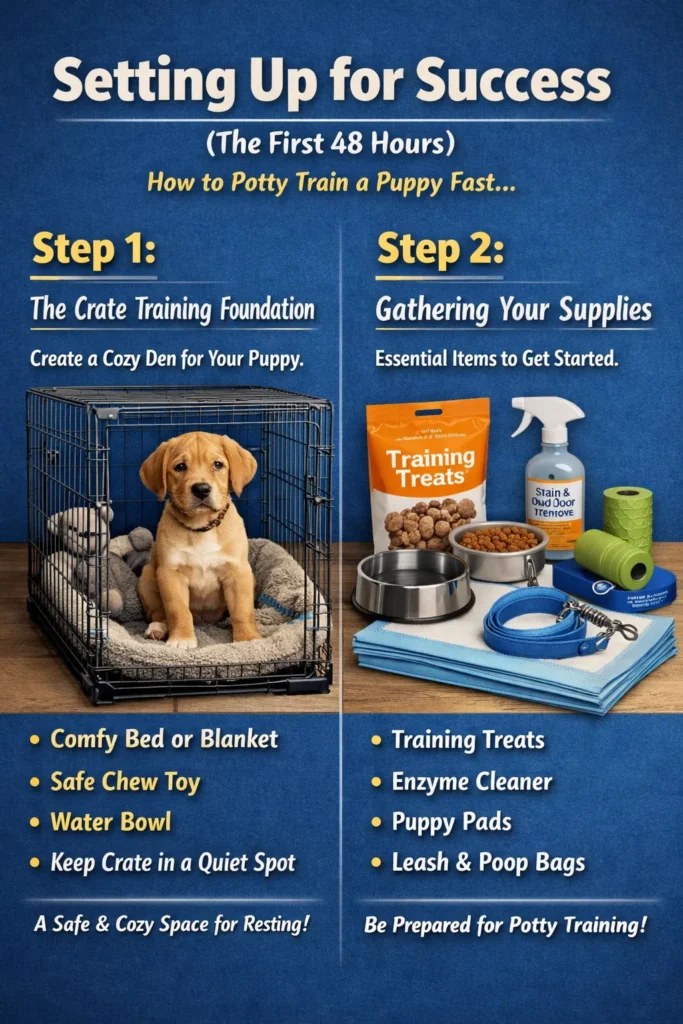
The Crate Training Foundation
Crate training is the single most effective tool for fast potty training. It leverages a dog’s natural instinct not to soil their sleeping area.
- Choosing the Crate: Select a crate that is large enough for your puppy to stand up, turn around and lie down comfortably. If it’s too large, they might use one corner as a toilet.
- Making it Inviting: Leave the door open initially, toss treats inside, and feed them their meals in the crate. This builds a positive association.
- Why it Works: A crate becomes a den. It also teaches your puppy what “hold it” means, because they don’t want to lie in their waste. This strengthens bladder control muscles and mental discipline quickly.
Gathering Your Supplies
Don’t start without the right tools:
- Enzymatic Cleaner: Regular cleaners don’t take away the smell of a pee to a puppy’s keen nose. An enzymatic cleaner (such as Nature’s Miracle) breaks down the enzymes, which eliminates the “bathroom scent” and discourages reoffense in that area of your home.
- High-Value Treats: Reserve special treats (like small pieces of boiled chicken or cheese) only for successful potty trips.
- Potty Bell (Optional): A bell hung on the door handle that your puppy can learn to ring when they need to go out.
- Leash and Harness: Use a leash for every potty break. This keeps them focused on the task rather than wandering off to play.
The Fast-Track Potty Training Schedule
Puppies thrive on routine. A predictable schedule helps their bodies develop a rhythm. For the fastest results, you must adhere to this schedule strictly for the first month.
The “Rule of Thumb”: In general, a puppy can hold his or her bladder for one hour per month of age. The 2-month-old puppy can hold it for only two hours. Though this is during the day when they are active. Better to be safe than sorry, always!
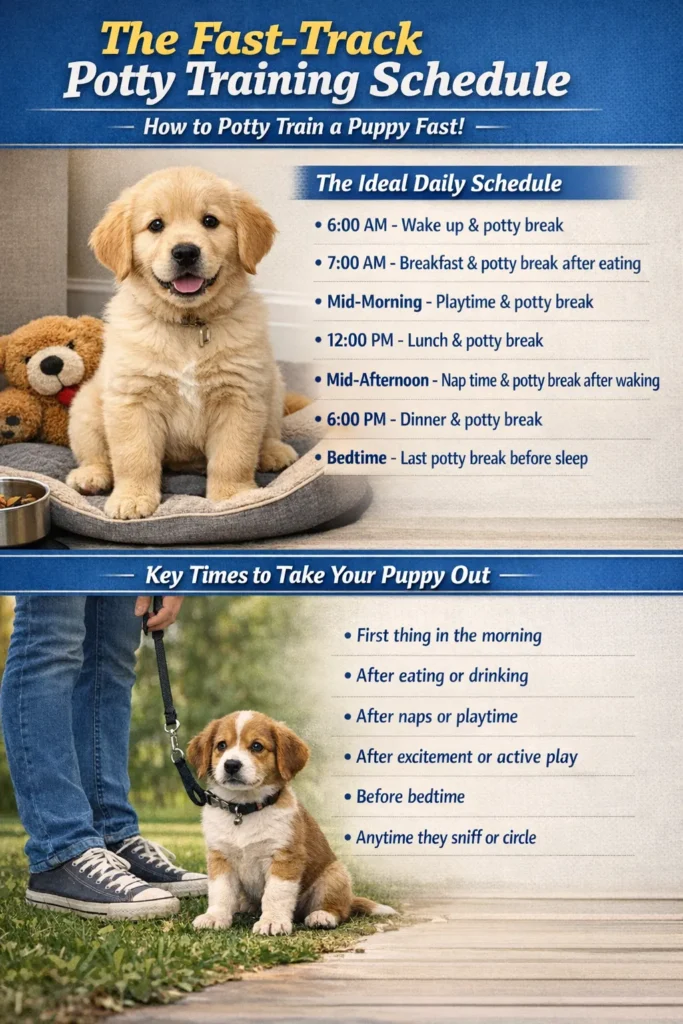
The Ideal Daily Schedule:
- 6:30 AM: Immediately take the puppy from the crate to the potty spot. This is non-negotiable. Carry them if necessary to prevent accidents on the way.
- 6:45 AM: Playtime and Breakfast. Give them 15-20 minutes to eat and drink.
- 7:15 AM: Potty Break #2. After eating, puppies almost always need to eliminate. Wait 5-10 minutes, then use the “Go Potty” command.
- 7:30 AM – 9:30 AM: Crate time with a safe chew toy. This is for your sanity and their nap.
- 9:30 AM: Potty Break #3. Out of the crate and straight outside.
- 9:45 AM: Training/Playtime.
- 10:30 AM: Potty Break #4.
- 10:45 AM – 1:00 PM: Crate time.
- 1:00 PM: Potty Break #5. (And lunch if applicable).
- Continue this pattern of “Out of Crate -> Potty -> Play/Train -> Potty -> Back in Crate” throughout the day.
Key Times to Take Your Puppy Out:
- First thing in the morning.
- Immediately after waking from a nap.
- Within 10-15 minutes after eating or drinking a lot.
- After intense play or exercise.
- Right before bedtime.
Mastering the Technique
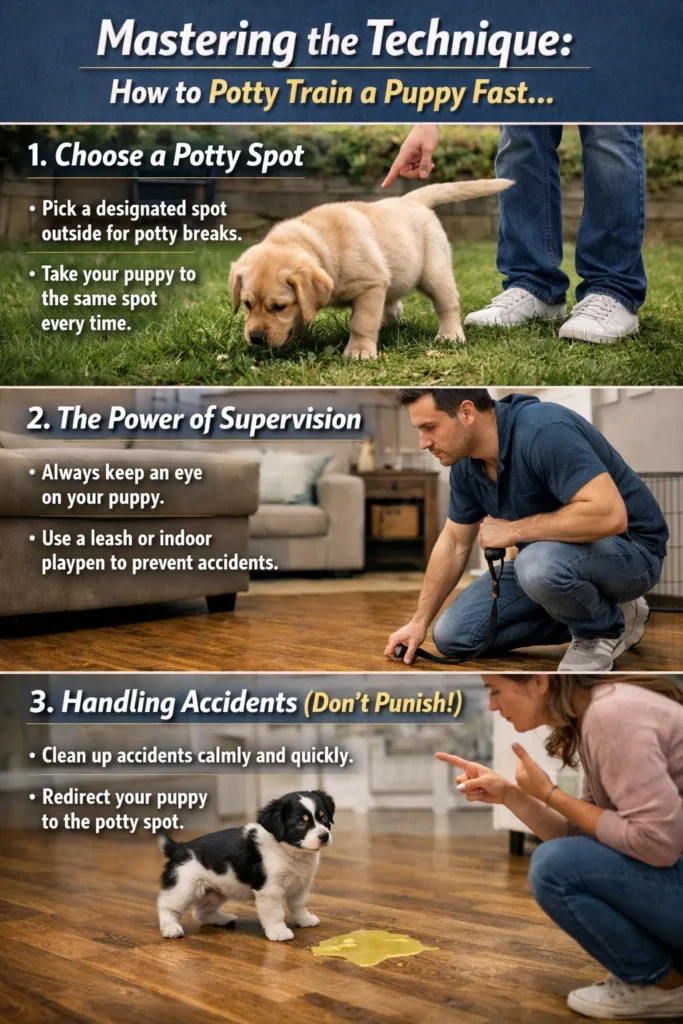
1. Choose a Potty Spot
Bring your puppy on a leash to the same spot in the yard every time. It will prompt them to leave based on the scent. Once you’re there, stay put and let them circle. Use a consistent command such as “Go Potty” or “Be Busy.” As they are sniffing, say it calmly. When they begin to leave, shh. Once they complete the task, praise excitedly and provide them with a high-value treat.
2. The Power of Supervision
When your puppy is not in their crate, they must be supervised 100% of the time.
- Tethering: Use a short leash to bring your puppy as close to you as possible while doing chores or watching television. This allows them to stay in your view. They want to sniff the ground in a circle right here as soon as you can just scoop them up and just run out.
- Confined Spaces: If you can’t actively watch them, they should be in their crate or a small, puppy-proofed area with pee pads (only if you plan to use them long-term).
3. Handling Accidents (Don’t Punish!)
Accidents will happen. When you see them doing it, clap or make a sudden noise to interrupt them (not terrify, just startle). Quickly take them outside to their spot. If they complete out there, compliment and reward.
If you discover a mess later, do nothing. There’s no sense cleaning it in front of them, they won’t connect your rage to the puddle from an hour ago. Just disinfect it well, using the enzymatic cleaner.
The 4-Week Potty Training Roadmap
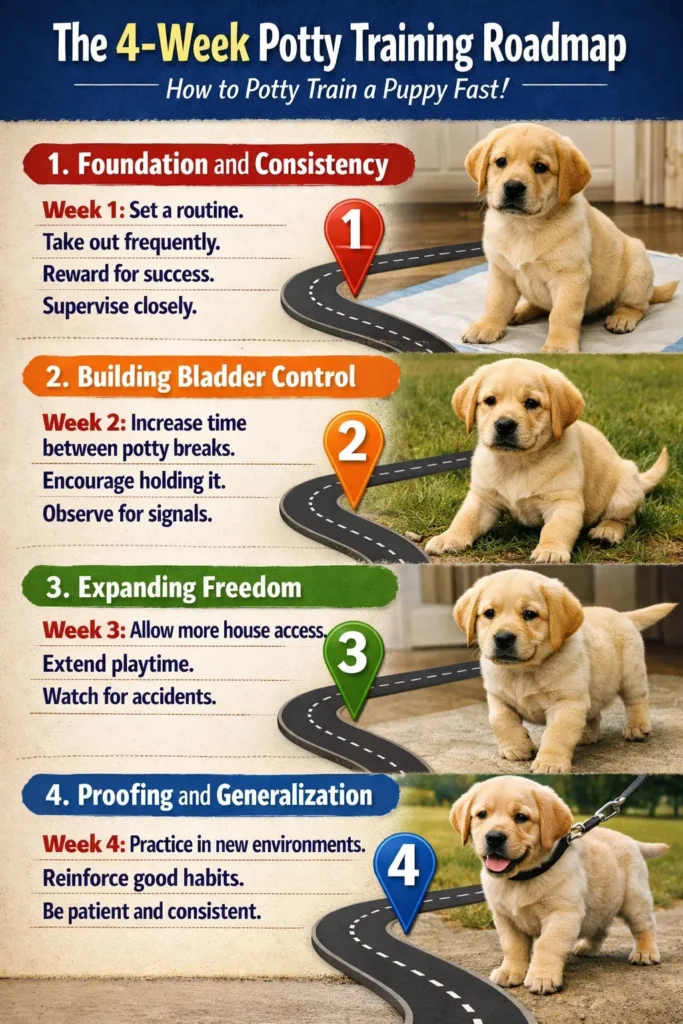
Week 1: Foundation and Consistency
- Goal: Build the schedule and create a strong association between the potty spot and rewards.
- Focus: Strict supervision, crate training, and hourly potty breaks. Expect 1-2 accidents per day. If you have more, you’re not taking them out enough.
- Nighttime: Set an alarm for once during the night (e.g., after 4 hours) for a quick, boring potty break. No play, just business and back to bed.
Week 2: Building Bladder Control
- Goal: Lengthen the time between breaks by 15-30 minutes.
- Focus: Your puppy is starting to learn. They might start going to the door on their own. If they do, treat this as a jackpot win!
- Introduce Bell Training: If using a bell, start gently nudging their nose or paw to the bell before you open the door. They’ll start to connect the action with going out.
Week 3: Expanding Freedom
- Goal: Test reliability in one new room.
- Focus: If your puppy has had zero accidents in their main area for 3-4 days, you can start giving them supervised access to one more room. Watch them like a hawk.
- Communication: By now, they should be signaling reliably—by sitting by the door, whining, or ringing the bell.
Week 4: Proofing and Generalization
- Goal: Maintain reliability even with distractions.
- Focus: Take your puppy to a friend’s house or a different part of the yard. Can they generalize that the “no potty inside” rule applies everywhere? This is the final test.
- Longer Holds: By now, a 4-month-old puppy should be able to hold it for 4 hours during the day.
Special Considerations for 2026
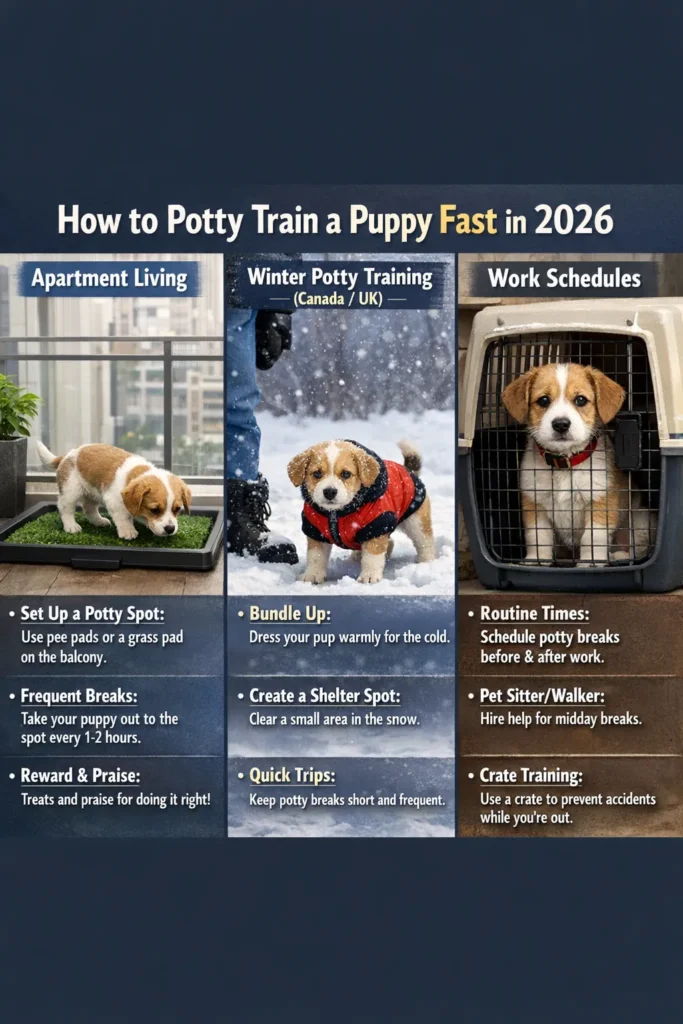
- Apartment Living: In a high-rise, time is of the essence. Take your puppy down the elevator. Do not simply let them walk because walking will make them want to go, and you don’t want them doing that in the hallway. For balconies, consider patches of real grass as a permanent “spot.”
- Winter Potty Training (Canada/UK): If the weather is cool or snowy, shovel out a potty patch and a path for your puppy. They may be eager to hurry out of the cold, so dress warmly and take your time. The same rules apply there; don’t rush them.
- Work Schedules: You can’t leave an 8 week old puppy alone for 8 hours if you work outside of the home. If you are going to be away for this long, you have to find a neighbor, friends, or professional pet sitter who can come mid-day in order to keep the plan on schedule for you.
Conclusion
Potty training a puppy fast doesn’t mean cutting corners; it means being more consistent and proactive than the average pooch owner. By investing in the crate, keeping a schedule, and being super diligent for four weeks, you will create an impenetrable foundation for your puppy’s life.
Keep in mind, your pup wants to make you happy. They do not have accidents to be “bad.” They have accidents because they are babies who don’t yet know the rules. Their success may be up to your patience and clarity. Hold on to the plan, celebrate the mini victories, and before you know it, the puddle days will be a thing of the past.
FAQ
1. How long does it take to potty train a puppy?
Feeding and potty training your pup will be solidified through much repetitive work but most puppies should become fully toilet trained utilising the crate training method by between 4 and 6 months. On the other hand, it can take only 2 to 4 weeks to train “fast”, or understanding the concept with very few accidents if you adhere to a stringent hourly schedule.
2. At what age should I start potty training?
You should begin when your puppy enters your home, typically around age 8 weeks. They might not be able to completely control their bladder, but you can start teaching them the schedule and where to go right away.
3. Is crate training cruel?
No. Crate training, if done correctly, is not cruel. Dogs are den creatures — they relish sitting in a confined area. It offers them some measure of refuge. It is only cruel if the puppy is left in the crate too long and forced to soil his bed.
4. My puppy pees when I’m not looking. How do I stop this?
This means you are not monitoring closely enough. Tether them to you: The tether method—keeping your puppy attached to you inside. It prevents them from wandering off to find a “bathroom spot” behind the couch.
5. Should I use potty pads or newspapers?
This is subject to your long-term aim. If your end goal is to have your dog potty outside, pads can be a bit confusing because you are showing them that going inside is ok. Apartment dwellers seeking a permanent indoor option should consider observing a designated “potty patch.” It you have to use pads, put them gradually nearer the door so they’ll go outside.
6. How do I stop my puppy from eating poop (Coprophagy)?
A common but annoying bad habit. Be sure to pick up the yard right after they leave. Another option is to sprinkle a deterrent supplement (such as pineapple or commercial products) on their food that makes the stool taste bad. Check in with your vet to eliminate nutritional deficiencies.
7. What is the best way to clean puppy accidents?
You need an enzymatic cleaner that works well on pet stains. Everyday household cleaners might wash out the stain, but they won’t extract the urine proteins. To the nose of a puppy that spot smells just like a toilet, so they are drawn back to it.
8. My puppy regressed and is having accidents again. Why?
Regression can also be common, usually between 4-6 months. Reasons can be: teething pain, urinary tract infection (UTI), besides changes in routine or simply “test” of boundaries. Return to basics with a rigid schedule for a week and visit your veterinarian to exclude UTI.
9. Should I punish my puppy for accidents?
Absolutely not. Punishment — particularly post hoc punishment — breeds only fear and anxiety. It trains your puppy that you to be afraid of you and that if they needed to go hide (and have an accident) in places where we won’t see it. Emphasize prevention and positive reinforcement.
10. How often should I take my puppy out at night?
An 8-week-old puppy usually needs one or two nighttime outings. The plan is to wake up, set the alarm for 4-5 hours after their normal bedtime. Lower the lights, don’t speak or play, take them directly to their potty place and right back in the crate. They can typically sleep through the night by 12 weeks.
11. How do I potty train a puppy in an apartment without a yard?
Pick a designated spot outside you can rush to. If you don’t have much of a walk to get there, carry your puppy so it doesn’t mess up hallways or elevators. If you have a balcony, a permanent toilet area can be a commercial “dog potty” using grass (real or artificial).
12. When can I give my puppy full run of the house?
You can only offer your puppy more freedom after he or she has been accident free in that area for at least 4-6 weeks. Grant freedom only one room at a time, even then. If they have an accident in the new room, you’ve expanded their territory too quickly — step back.
Final Verdict
Potty training a puppy quickly is one of the most difficult but rewarding parts of having a new dog in your home! It will test your patience, your consistency and your ability to get up at 6:30 AM with no complaints. But by taking on the role of coach instead of punisher, you build a foundation for lifelong clarity and trust with your dog.
The methods we describe in this guide—strict scheduling, crate training and positive reinforcement—arent fads; they are the foundation of modern, effective dog training praised by vets and behaviorists throughout the U.S., U.K. and Canada. Keep in mind that all puppies are unique. Some learn it in two weeks and some take a full month. The endless comparisons, Your puppy journey is not the same as everyone else. The time spent in the early weeks pays back a thousandfold for years to come, when you have a well-adjusted, housebroken dog who is a pleasure to live with. So, keep it up and stay positive, success will be yours.
Affiliate Product Suggetion
consistency and vigilance



Leave a Reply