Let’s be real: nothing ruins the feel of a lovely home quite like the odoriferous, tear-inducing stench of cat pee. You love your cat, but that pungent ammonia odor that haunts your carpets or floorboards or best-loved sofa is a nightmare the average household cleaning product can’t approach. If you know how frustrating it is to scrub until your hands ache just for the smell to come back on a humid day, you may have been there.
The issue is not your cleaning effort, but the urine and its chemistry. In this Complete Guide to 2026, we will show you exactly why cat pee is so difficult to kill and we offer the best, straightforward iterations of cleaning techniques that eliminate it forever. We’ve got you covered from the best commercial enzyme cleaners to simple at-home natural solutions. In this guide, how to remove cat urine odor you’ll have your home smelling fresh by the end with tips to keep future accidents at bay!
In this complete guide, you’ll discover:
- The biological reason why cat urine smells so strong (and why soap fails).
- The Top 5 Enzyme Cleaners available in 2026 for US and UK markets.
- Simple DIY recipes using pantry staples like vinegar and peroxide.
- Step-by-step instructions for cleaning carpets, hardwood, and laundry.
- How to find “invisible” old stains using UV light technology.
- Proactive Pet Hygiene Tips to stop your cat from peeing outside the box.
The biological reason why cat urine smells so strong (and why soap fails).
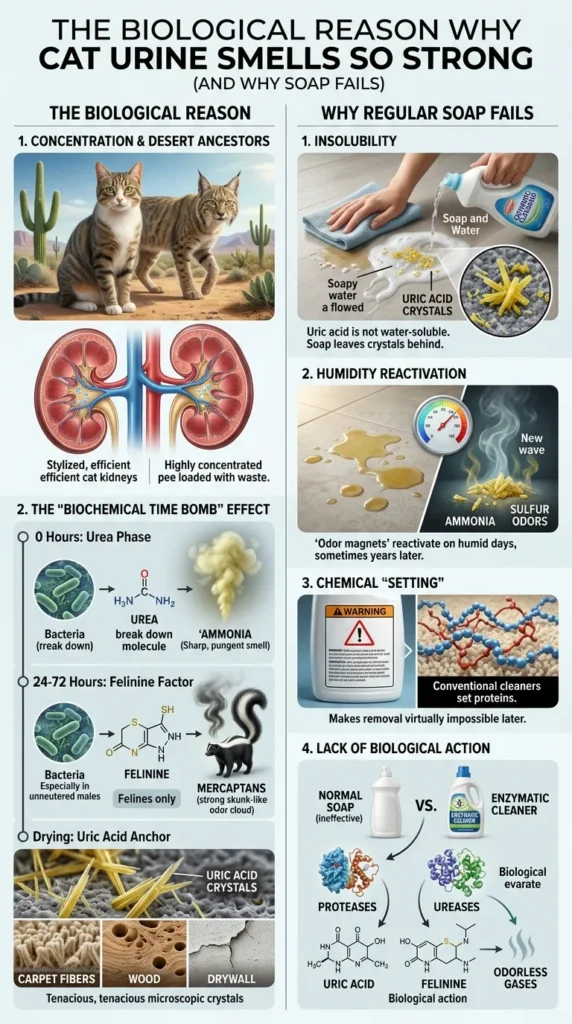
The main biological reason cat pee smells so strong is that it’s so concentrated, with something called felinine in it. Unlike humans or dogs, cats descended from ancestors that roamed the desert, and their kidneys are particularly good at holding water, producing very concentrated pee loaded with waste materials.
The “Biochemical Time Bomb” Effect
The scent of cat urine actually changes and worsens over time due to a multi-stage decomposition process:
- The Urea Phase: Bacteria immediately begin breaking down urea into ammonia, creating that initial sharp, pungent smell.
- The Feminine Factor: Cats (especially unneutered males) secrete felinine, a sulfur-containing amino acid that only exists in felines. Bacteria then break it down over 24–72 hours into volatile sulfur compounds known as mercaptans — the same type of molecules that provide skunk spray its foul aroma.
- The Uric Acid Anchor: Uric acid is the most tenacious component. When the urine dries, this acid crystallizes into microscopic, needle-like crystals that adhere strongly to porous surfaces (wood, carpet fibers and drywall).
Why Regular Soap Fails
Plain old household soaps and detergents work great for general surface dirt and water-soluble stains, but they aren’t up to the unique chemistry of cat pee because:
- Insolubility: Uric acid is not water-soluble. Soap and water may wash away the urea and the initial ammonia smell, but they leave the uric acid crystals behind.
- Humidity Reactivation: The crystals are still embedded, acting as “odor magnets.” On humid days or when you wet mop with water, he explained, these crystals rehydrate and release a new wave of ammonia and sulfur odors — sometimes years later.
- Chemical “Setting”: Conventional cleaners have been known to actually set urine protein into the fibers which then makes it virtually impossible to remove later even with professional grade tools.
- Lack of Biological Action: Only enzymatic cleaners have the specific “biological machines” (proteases and ureases) required to break the chemical chains of uric acid and felinine through physical action, converting them into odorless gases that can finally evaporate.
The Top 5 Enzyme Cleaners available in 2026 for US and UK markets.
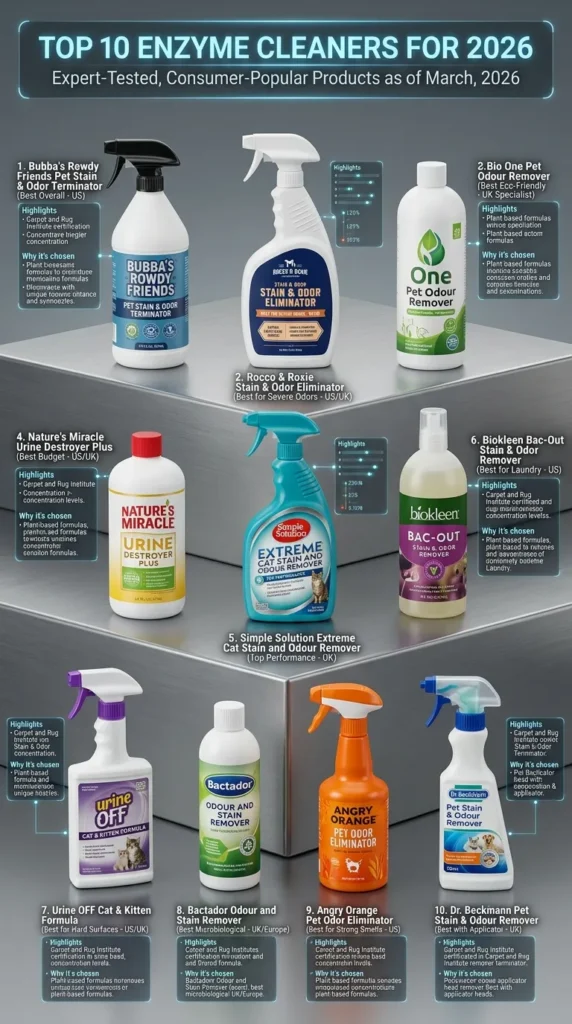
In 2026, the best enzyme cleaners for cat urine in the US & UK use advanced bio-enzymatic formulas that not only cover-up odors but break down uric acid crystals. Here are the 10 best-selling products according to expert testing and consumer popularity as of March, 2026.
Top 10 Enzyme Cleaners for 2026
- Bubba’s Rowdy Friends Pet Stain & Odor Terminator (Best Overall – US)
- Highlights: Always comes out on top for both fresh and set-in stains. It features a professional-grade enzyme blend that will not damage carpets, upholstery or even hardwood floors.
- Why it’s chosen: It is certified by the Carpet and Rug Institute for its efficacy in removing odors without damaging fibers.
- Rocco & Roxie Stain & Odor Eliminator (Best for Severe Odors – US/UK)
- Highlights: A perennial favorite available in both markets. It has high concentrations of enzymes that specifically attack the ammonia and sulfur compounds in cat spray.
- Why it’s chosen: It is widely considered the most “reliable” spray for deep saturation of thick rugs.
- Bio One Pet Odour Remover (Best Eco-Friendly – UK Specialist)
- Highlights: Affordable and accessible; generally available at major retailers such as Chewy and Amazon The “Plus” formula is designed specifically to combat cat messes.
- Why it’s chosen: It uses active “hungry” enzymes to dismantle biological structures on contact.
- Nature’s Miracle Urine Destroyer Plus (Best Budget – US/UK)
- Highlights: Plant-based favorite with the addition of live enzyme cultures & citrus extracts. It works particularly well if added directly to a washing machine, saving urine-soaked bedding.
- Why it’s chosen: It offers quick action on fresh stains and includes a light citrus scent that doesn’t overwhelm.
- Simple Solution Extreme Cat Stain and Odour Remover (Top Performance – UK)
- Highlights: Known for its “3X Pro-Bacteria” formula, it is one of the best-selling products on Amazon UK. It is safe for all colorfast carpets and upholstery.
- Why it’s chosen: Its specialized nozzle allows for mist, stream, or foam application depending on the surface.
- Biokleen Bac-Out Stain & Odor Remover (Best for Laundry – US)
- Highlights: In European and UK pro tests of “outrageous” hygiene (and permanent odor removal), regularly cited as higher than the best.
- Why it’s selected: It takes a microbiological approach to eat up the organic source of the odor.
- Why it’s chosen: It contains no artificial fragrances or dyes, making it ideal for cats with allergies.
- Urine OFF Cat & Kitten Formula (Best for Hard Surfaces – US/UK)
- Highlights: A veterinarian-recommended formula that specifically targets the uric acid crystals that bond to subfloors and tile grout.
- Why it’s chosen: It is a USDA-certified bio-based product, ensuring a high percentage of natural biological ingredients.
- Bactador Odour and Stain Remover (Best Microbiological – UK/Europe)
- Highlights: Frequently highly rated in European and UK professional tests for “exceptional” hygiene and permanent odor removal.
- Why it’s chosen: It uses a microbiological approach to digest the organic source of the smell.
- Angry Orange Pet Odor Eliminator (Best for Strong Smells – US)
- Highlights: Developed from industrial-strength cleaners used on kennels and feedlots, this home-safe version packs heavy-duty deodorizing power.
- Why it’s chosen: It leaves a powerful, fresh orange scent that effectively masks odors while the enzymes work.
- Dr. Beckmann Pet Stain & Odour Remover (Best with Applicator – UK)
- Highlights: Features a unique 2-in-1 brush head that helps work the oxy-powered enzymatic formula deep into carpet fibers.
- Why it’s chosen: Excellent for “spot” cleaning where you need physical agitation to break up dried residue.
Step-by-step instructions for cleaning carpets, hardwood, and laundry.
Removing cat pee is a little more involved because each surface needs to be treated differently, or you could end up permanently damaging the item you’re trying to clean or leaving odors behind. Here’s your 2026 Master Guide to cleaning those three surfaces.
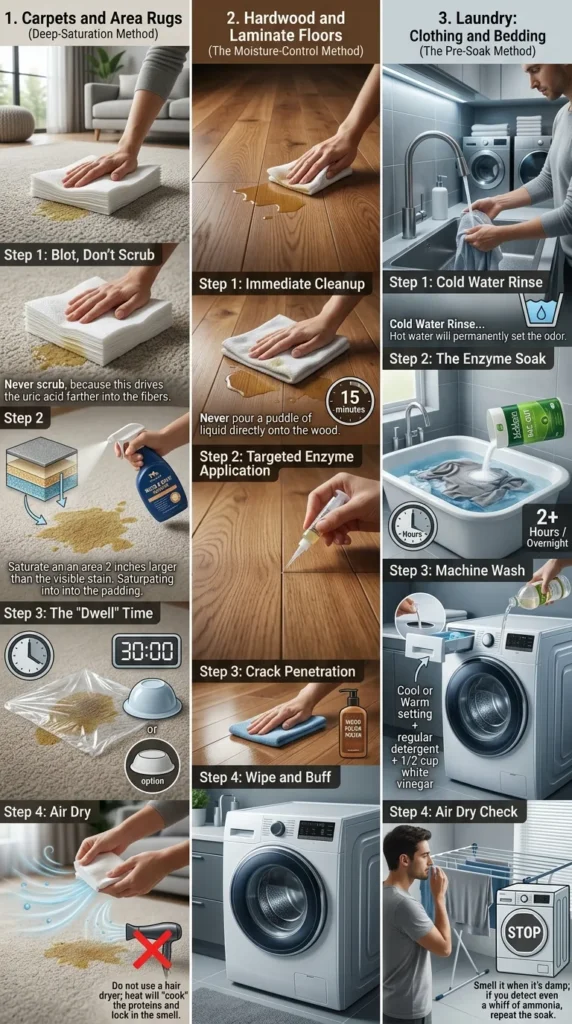
1. Carpets and Area Rugs (Deep-Saturation Method)
Carpets are the hardest to clean because urine travels downward into the padding and subfloor.
- Step 1: Blot, Don’t Scrub. Work with a thick stack of paper towels or an old white cloth. Press down hard (or stand on it) to soak up as much liquid fresh stuff as you can. Never scrub, because this drives the uric acid farther into the fibers.
- Step 2: This is where the enzyme cleaner comes into play. Spray or pour the enzyme cleaner (such as something like Rocco & Roxie) over the area. Apply enough to saturate the carpet and padding beneath. The cleaner only needs to be 2 inches larger than the stained area on all sides.
- Step 3: The “Dwell” Time. The “Dwell” Time. If using the ribbon method, let it rest for at least 30–60 minutes. For old, stubborn stains, drape a piece of plastic wrap or an inverted bowl over the damp spot to minimize evaporation and give the enzymes more time to “eat” those crystals.
- Step 4: Air Dry. Blot up the excess cleaner and let the area air dry naturally. Do not use a hair dryer; heat will “cook” the proteins and lock in the smell.
2. Hardwood and Laminate Floors (The Moisture-Control Method)
The goal here is to neutralize the acid without warping the wood or stripping the finish.
- Step 1: Immediate Cleanup. Wipe up the urine immediately. If it has seeped into the cracks between boards, you’ll need a more intensive soak.
- Step 2: Targeted Enzyme Application. Use a good wood-safe enzyme cleaner Saturate a cloth and place the moist cloth on the stain for 15 minutes. Never pour a puddle of liquid directly onto the wood, which can leave surface swelling.
- Step 3: Crack Penetration. If the smell persists, use a syringe or a fine-tip bottle to drop small amounts of cleaner directly into the seams between the boards.
- Step 4: Wipe and Buff. Wipe the area dry with a clean microfiber cloth. Once dry, you may want to apply a wood polish to restore the protective seal.
3. Laundry: Clothing and Bedding (The Pre-Soak Method)
Standard detergent won’t work on its own. You need a biological boost.
- Step 1: Cold Water Rinse. Rinse the item in a sink with cold water only. Hot water will permanently set the odor into the fabric fibers.
- Step 2: The Enzyme Soak. Soak the item in a tub of cool water containing 1 cup of an enzymatic laundry booster (such as Biokleen Bac-Out). Allow it to soak for at least 2 hours (overnight is better if there are heavy smells).
- Step 3: Machine Wash. Machine Wash — Wash the item in a “Cool” or “Warm” setting machine. And use your regular detergent, plus 1/2 cup of white vinegar, in the fabric softener compartment to help strip any lingering mineral salts.
- Step 4: Air Dry Check. Air Dry Check. You should not put it in the dryer until you are completely certain that the smell is out. Smell it when it’s damp; if you detect even a whiff of ammonia, repeat the soak. The dryer’s high heat will solidify that smell.
Pro Tip for 2026
Check your work with UV Blacklight (365nm). If the spot still reflects a noxious yellow-green after cleaning, the uric acid crystals remain and need another dose of enzyme treatment.
Do you want a list of ways to keep your cat from coming back to such spots.
Proactive Pet Hygiene Tips to stop your cat from peeing outside the box.
The only way to stop your cat from peeing outside the box is to understand the biological, environmental and psychological reasons that are causing her to do so. If it still smells like a “bathroom” to their sensitive nose, they come back.
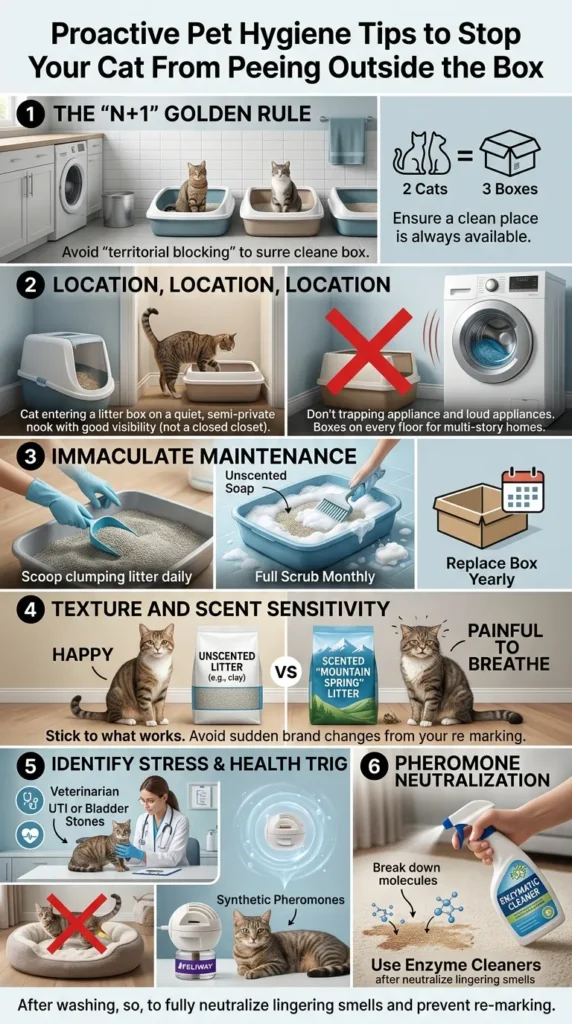
1. The “N+1” Golden Rule
The rule of thumb: always have one more litter box than you do cats. One box for one cat, two boxes for two. This avoids “territorial blocking” as well, so if one box becomes soiled, there’s always a clean place to go.
2. Location, Location, Location
- Privacy but Visibility: Cats feel vulnerable when peeing. Place boxes in quiet areas but avoid “trapping” them (like a closet with only one exit).
- Avoid “Loud” Appliances: Don’t put the box next to a noisy washing machine or furnace that might startle them.
- Split the Levels: If you have a multi-story home, place at least one box on every floor. A senior cat or a busy kitten may not make it up two flights of stairs in time.
3. Immaculate Maintenance
- Scoop Daily: Cats are fastidious. A dirty box is the #1 reason for “out-of-box” accidents.
- Full Scrub Monthly: Once a month, dump all litter and scrub the box with unscented soap and water. Avoid ammonia-based cleaners, as they smell like urine to a cat.
- Replace the Box Yearly: Plastic is porous and absorbs odors over time. Even a clean-looking old box can smell “full” to a cat.
4. Texture and Scent Sensitivity
- Unscented is Best: Humans like “Mountain Spring” scents, but a cat’s nose is 14 times stronger. Scented litters can be physically painful for them to breathe in.
- Stick to what works: If you find a brand they like, do not switch. Cats are creatures of habit; a sudden change in texture (e.g., switching from clay to pine) can trigger a strike.
5. Identify Stress & Health Triggers
- The Vet Check: If a perfectly trained cat suddenly pees on your bed, it is often a UTI or bladder stones. They associate the litter box with pain and look for “soft” places to go.
- Feliway/Pheromones: If the issue is stress-related (a new baby, a new pet, or a move), use a synthetic pheromone diffuser like Feliway to lower their anxiety levels.
6. Pheromone Neutralization
For example, after washing away an accident with an enzyme cleaner, spray a no-no spray .
FAQs
- Does vinegar actually kill cat urine smell? Yes, the acid neutralizes the alkaline salts, but it usually requires a follow-up enzyme treatment for permanent results.
- Can I use bleach on cat pee? NEVER. Mixing bleach with the ammonia in cat urine can create toxic chloramine gas.
- Why does the smell come back when it rains? Humidity reactivates dried uric acid crystals. Only enzyme cleaners can dissolve these crystals.
- How do I find a smell if I can’t see the stain? Use a 365nm UV Blacklight; cat urine glows a dull yellow/green.
- Is old cat urine impossible to remove? No, but it requires “wetting” the area with enzymes and covering it with plastic to keep it active longer.
- Will baking soda hurt my cat? In small amounts for cleaning, it’s safe, but don’t let them ingest large quantities.
- How long do enzyme cleaners take to work? Usually 24–48 hours to fully break down the molecules.
- What is the best way to clean cat pee off a mattress? Blot, saturate with enzyme cleaner, and use a carpet extractor or heavy towels with weights.
- Can laundry detergent remove urine? Only if it contains proteases/enzymes. Regular detergent just masks the scent.
- Why is my cat peeing on my clothes? This is often a sign of stress or a urinary tract infection; consult a vet.
- Do “No-Marking” sprays work? They help as a deterrent, but cleaning the original pheromones is more effective.
- Is there a professional service for this? Yes, look for “Biohazard” or “Pet Restoration” cleaning specialists in your local area. [11, 12, 13, 14, 15]
Final Verdict
Removing the smell of cat pee is not only a matter of sanitary but also keeps your friendship with your pet intact. In 2026, we have a lot of weapons — from complex enzymatic formulas to high-tech UV sensors — when it comes to keeping our homes clean and bright. Patience and the right chemistry are key to success in life. [16]
The makeup (as I call it) is not good enough: The only way you cure in this case is molecular breakdown, never mask with perfumes. You can enjoy your pet cat and not have the shame of a smelly apartment by following this guide with these Pet Care Basics and Hygiene Tips. Keep in mind, how to remove cat urine odor if your cat’s behavior changes suddenly, always first rule out any possible health issues. Your home can be a clean, fresh and odor-free sanctuary for you and your cat.
Do you want me to elaborate on the specific DIY recipes, or add a product comparison table for best 2026 enzyme cleaners?


Leave a Reply