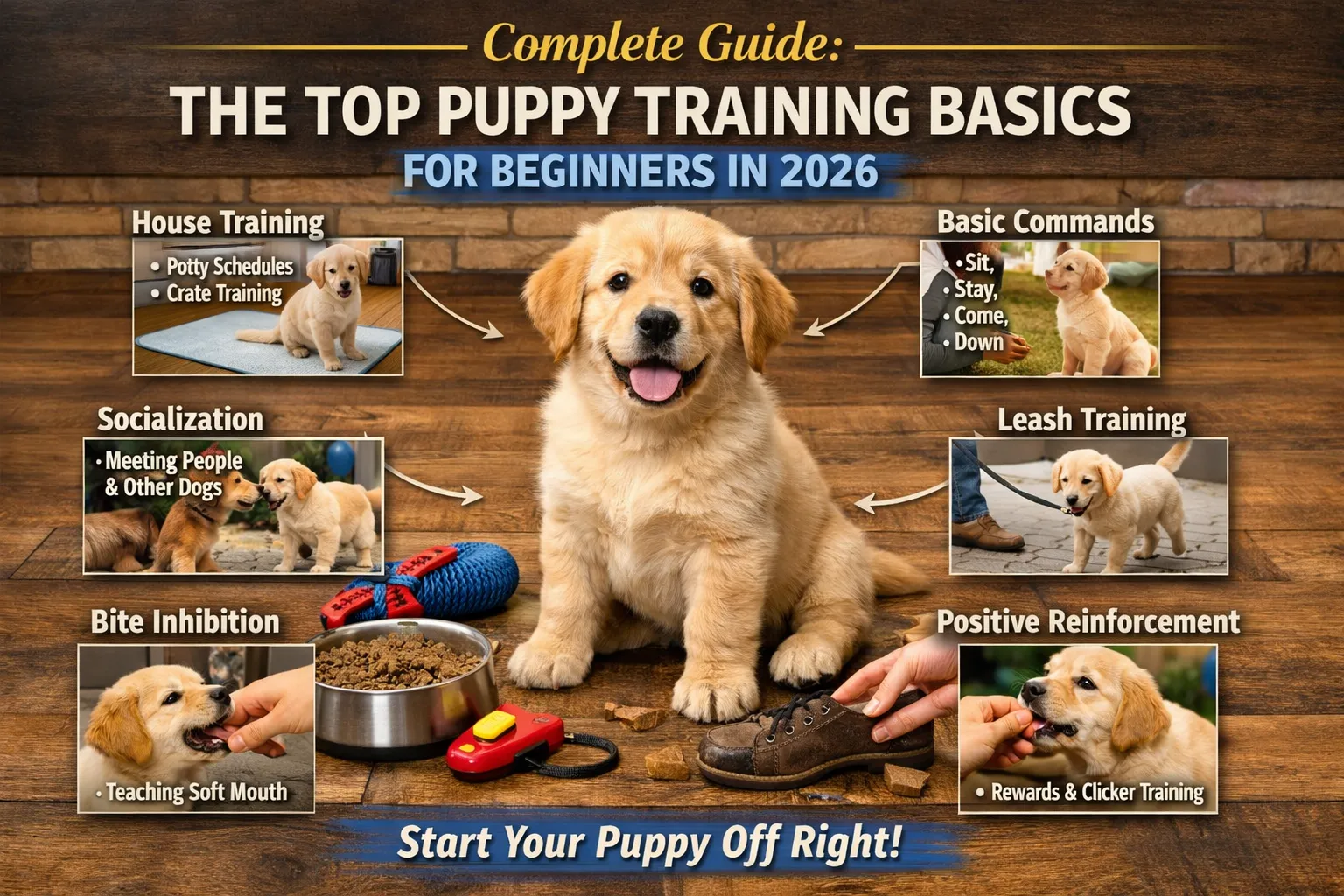
Adopting a new furry friend in 2026 is an exciting milestone, but along with this big life event comes all the challenges you never knew you were going to have—like midnight potty breaks and destroyed shoes. The most essential step you can take toward a peaceful home and a secure pet is to learn puppy training basics for beginners. Intervening at an early age is crucial to avoid long-term Dog Behavior Issues and helps build a clear communication pathway between you and your pup. The challenge many new owners run into is “information overload” — with so many different conflicting methods out there, it can be hard to know how to actually get started without adding confusion.
This guide promises to offer a clear, high-quality roadmap to puppy success! In this ultimate guide on how to train a puppy, we’ll lay out all the essential building blocks of science-based positive reinforcement puppy training for beginners in four simple-to-follow daily routines. At Petscarex. At Petlyfe. Using our Socialization Guide and Pet Safety Tips, you will learn the top secrets for raising a well-rounded pup that thrives in the 2026 world.
In this complete guide, you’ll discover:
- The Best Puppy Training Basics for Beginners in 2026.
- How to master Potty Training and Crate Training in record time.
- The top 5 essential commands (Sit, Stay, Come, Down, Leave It).
- Expert Socialization Guide techniques for a confident, fearless dog.
- A simple 2026 schedule to balance play, naps, and training.
Bringing home a puppy in 2026 is exciting — but it’s also overwhelming.
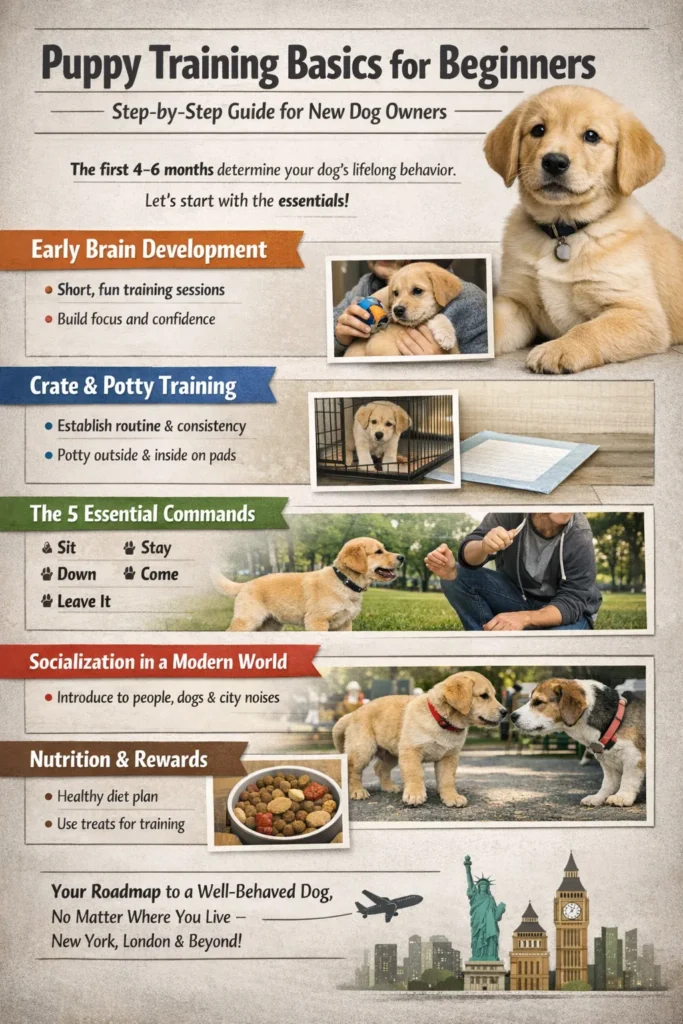
Between hybrid work schedules, city living, rising pet product options, and new training philosophies, many first-time dog owners feel unsure where to begin.
The truth?
The first 4–6 months determine your dog’s lifelong behavior.
This guide walks you step-by-step through:
- Early brain development
- Crate and potty training
- The five essential commands
- Socialization in a modern world
- Nutrition and reward systems
Whether you live in New York, London, or a smaller town, these fundamentals apply universally.
The Critical Socialization Window (First 16 Weeks in 2026)
Puppies are born neurologically immature. From birth to approximately 16 weeks, their brains are in a rapid developmental phase known as the critical socialization window.
During this period:
- The brain forms neural pathways at an accelerated rate
- Fear responses are still developing
- New experiences are more easily accepted
After 16 weeks, novelty becomes more likely to trigger caution or fear.
Why This Matters in 2026
Modern puppies experience:
- Apartment living
- Elevators
- Traffic noise
- Delivery drivers
- Doorbells from smart home systems
- Hybrid-work transitions
If these stimuli are introduced early and positively, your puppy grows into a confident adult dog.
If not, you may see:
- Reactivity
- Fear-based aggression
- Noise phobias
- Social anxiety
What Should Puppies Experience Before 16 Weeks?
- Different floor textures (wood, tile, grass, gravel)
- City sounds (traffic, sirens, crowds)
- Different people (hats, glasses, children)
- Controlled exposure to vaccinated dogs
- Grooming tools
- Car rides
The goal is not overwhelm — it’s positive, gradual exposure.
Positive Reinforcement: The Science Behind Rewards
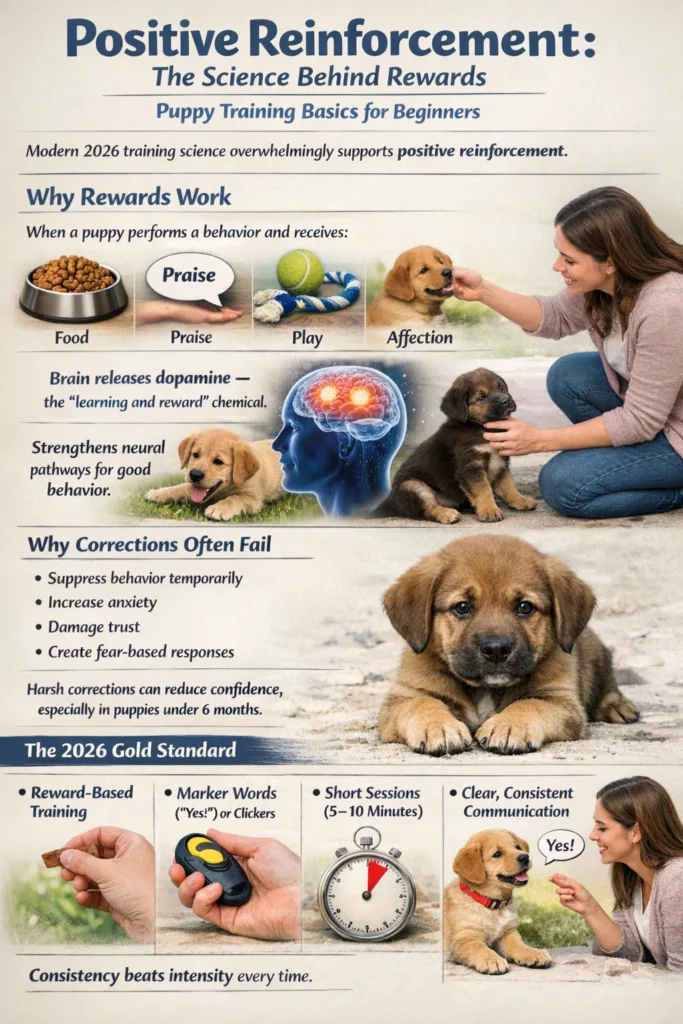
Modern 2026 training science overwhelmingly supports positive reinforcement.
Why Rewards Work
When a puppy performs a behavior and receives:
- Food
- Praise
- Play
- Affection
The brain releases dopamine — the “learning and reward” chemical.
This strengthens neural pathways associated with that behavior.
Why Corrections Often Fail
Harsh corrections may:
- Suppress behavior temporarily
- Increase anxiety
- Damage trust
- Create fear-based responses
Especially in puppies under 6 months, correction-based training can reduce confidenceThe 2026 Gold Standard
- Reward-based training
- Marker words (“Yes!”) or clickers
- Clear, consistent communication
- Short sessions (5–10 minutes)
Consistency beats intensity every time.
Preventing Separation Anxiety in a Post-Hybrid Work World
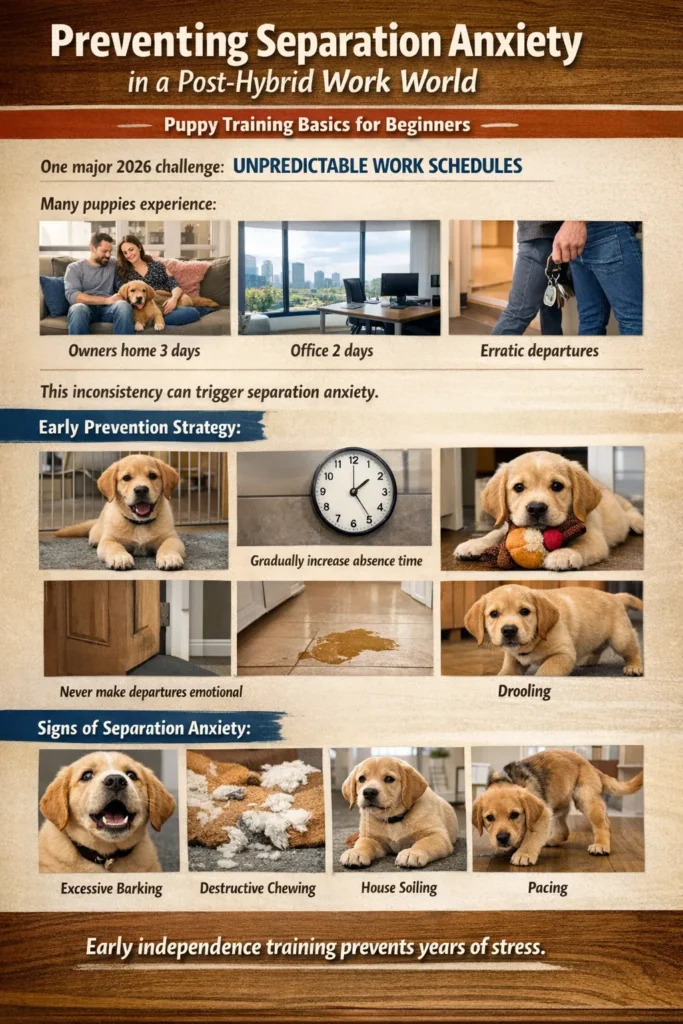
One major 2026 challenge: unpredictable work schedules.
Many puppies experience:
- Owners home 3 days
- Office 2 days
- Erratic departures
This inconsistency can trigger separation anxiety.
Early Prevention Strategy
- Practice short separations daily (1–5 minutes)
- Gradually increase absence time
- Never make departures emotional
- Provide enrichment toys during alone time
Signs of Separation Anxiety
- Excessive barking
- Destructive chewing
- House soiling
- Drooling
- Pacing
Early independence training prevents years of stress.
The Best Crate Setup (2026 Product Trends)
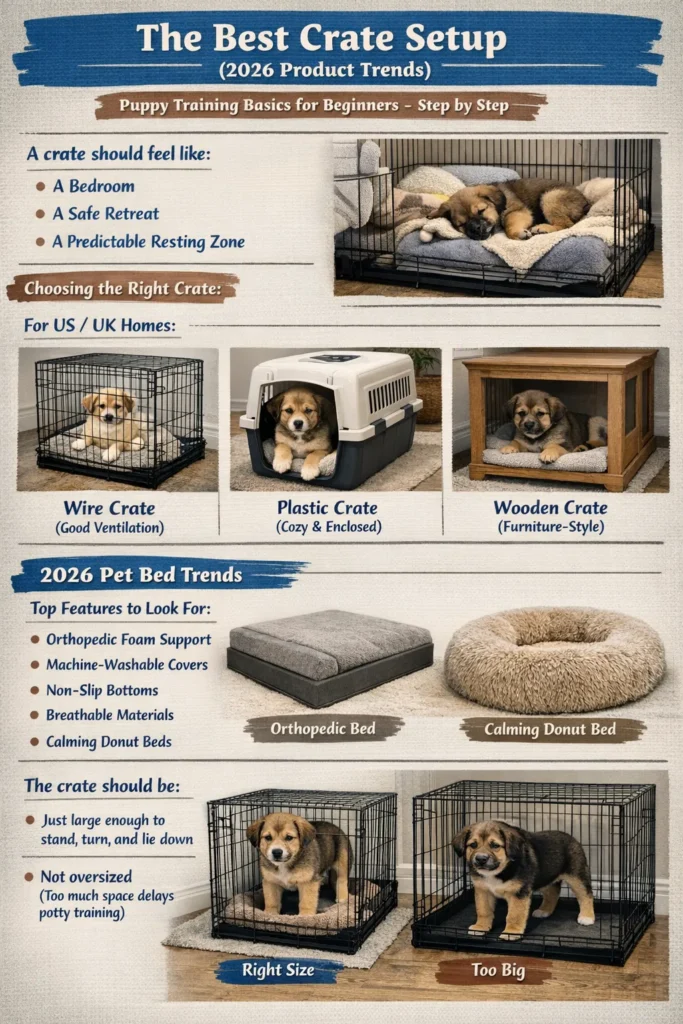
A crate should feel like:
- A bedroom
- A safe retreat
- A predictable resting zone
Choosing the Right Crate
For US/UK homes:
- Wire crates (good ventilation)
- Plastic airline crates (cozier)
- Furniture-style wooden crates (popular in 2026 modern apartments)
2026 Pet Bed Trends
Top features to look for:
- Orthopedic foam support
- Machine-washable covers
- Non-slip bottoms
- Breathable materials
- Calming donut-style designs
The crate should be:
- Just large enough to stand, turn, and lie down
- Not oversized (too much space delays potty training)
The 15-Minute Rule: Potty Training Simplified
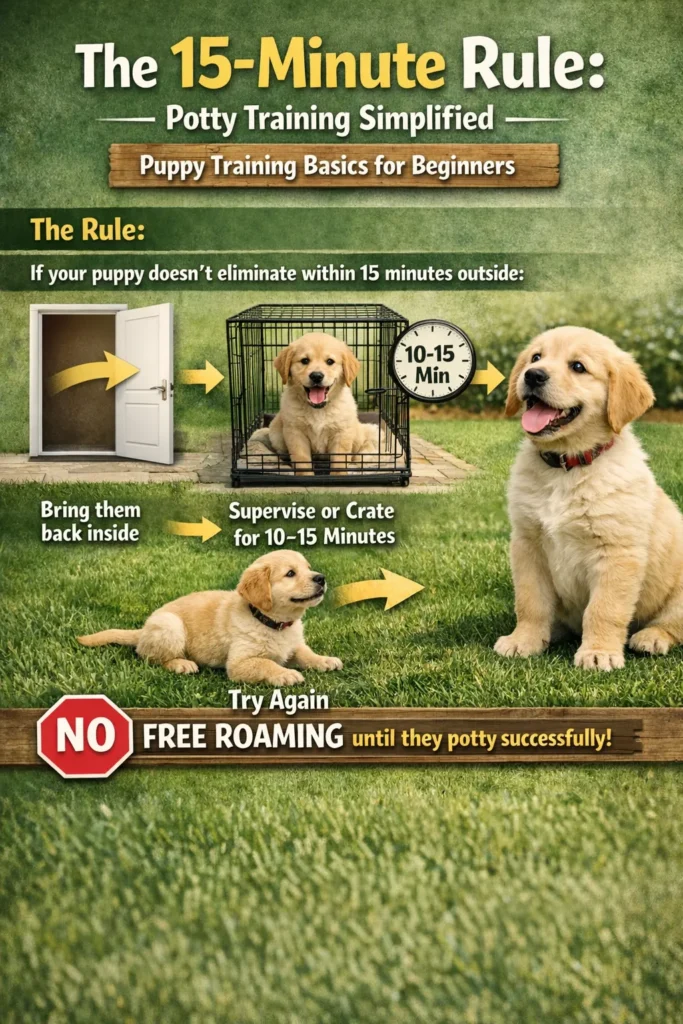
This is one of the most effective beginner systems.
The Rule:
If your puppy doesn’t eliminate within 15 minutes outside:
→ Bring them back inside
→ Supervise or crate for 10–15 minutes
→ Try again
No free roaming until they potty successfully.
When to Take Your Puppy Out
- Immediately after waking
- After eating
- After drinking
- After play
- Every 1–2 hours (young puppies)
Young puppies can hold urine approximately:
- 2 months old = 2 hours
- 3 months old = 3 hours
Accident Cleanup: Preventing Repeat Mistakes
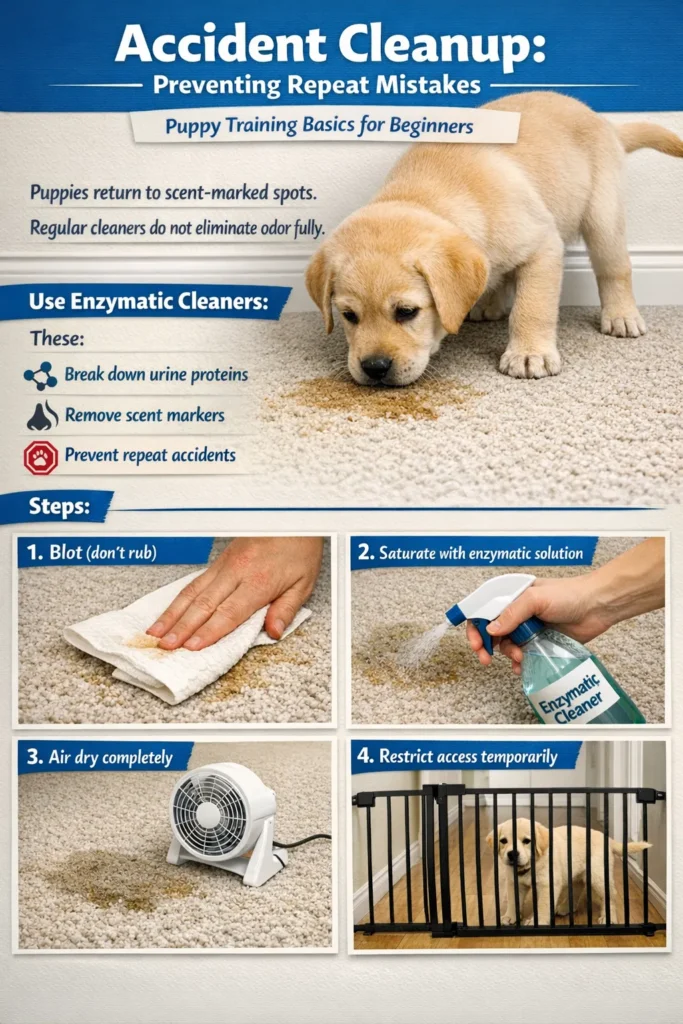
Puppies return to scent-marked spots.
Regular cleaners do not eliminate odor fully.
Use Enzymatic Cleaners
These:
- Break down urine proteins
- Remove scent markers
- Prevent repeat accidents
Steps:
- Blot (don’t rub)
- Saturate with enzymatic solution
- Air dry completely
- Restrict access temporarily
Avoid ammonia-based cleaners — they smell like urine to dogs.
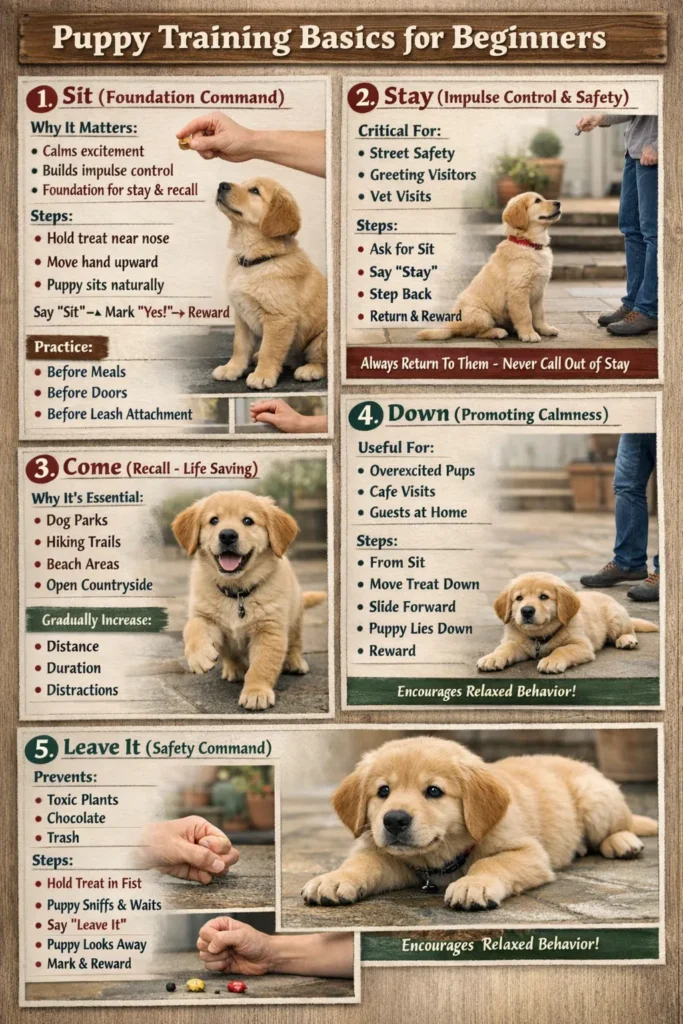
1. Sit (Foundation Command)
Why it matters:
- Calms excitement
- Builds impulse control
- Foundation for stay and recall
Steps:
- Hold treat near nose
- Move hand upward
- Puppy’s bottom lowers naturally
- Say “Sit”
- Mark (“Yes!”)
- Reward
Practice:
- Before meals
- Before opening doors
- Before leash attachment
2. Stay (Impulse Control & Safety)
Critical for:
- Street safety
- Greeting visitors
- Vet visits
Steps:
- Ask for Sit
- Say “Stay”
- Take one step back
- Return immediately
- Reward
Gradually increase:
- Distance
- Duration
- Distractions
Never call them out of Stay initially — return to them first.
3. Come (Recall – Life-Saving Command)
This is non-negotiable.
Why Every US/UK Owner Needs Recall
- Dog parks
- Hiking trails
- Beach areas
- Open countryside
Steps:
- Start indoors
- Say puppy’s name
- Say “Come!” excitedly
- Reward heavily
- Never punish after recall
Make recall:
- Always positive
- Always rewarding
- Never associated with scolding
4. Down (Promoting Calmness)
Useful for:
- Overstimulated puppies
- Cafe outings
- Guests at home
Steps:
- From Sit
- Move treat downward
- Slide forward
- Puppy follows
- Reward
This encourages relaxed behavior.
5. Leave It (Safety Command)
Protects from:
- Toxic spring plants
- Chocolate
- Household hazards
- Trash
Steps:
- Hold treat in closed fist
- Puppy sniffs
- Wait
- When puppy looks away → mark and reward from other hand
Build toward dropping objects on floor.
The 2026 Socialization Guide
Expose gradually to:
- Vacuum sounds
- Hair dryers
- Fireworks recordings
- Bicycles
- Skateboards
- Public transit
- Children playing
Always pair exposure with treats.
Never force interaction.
Bathing & Grooming Introduction
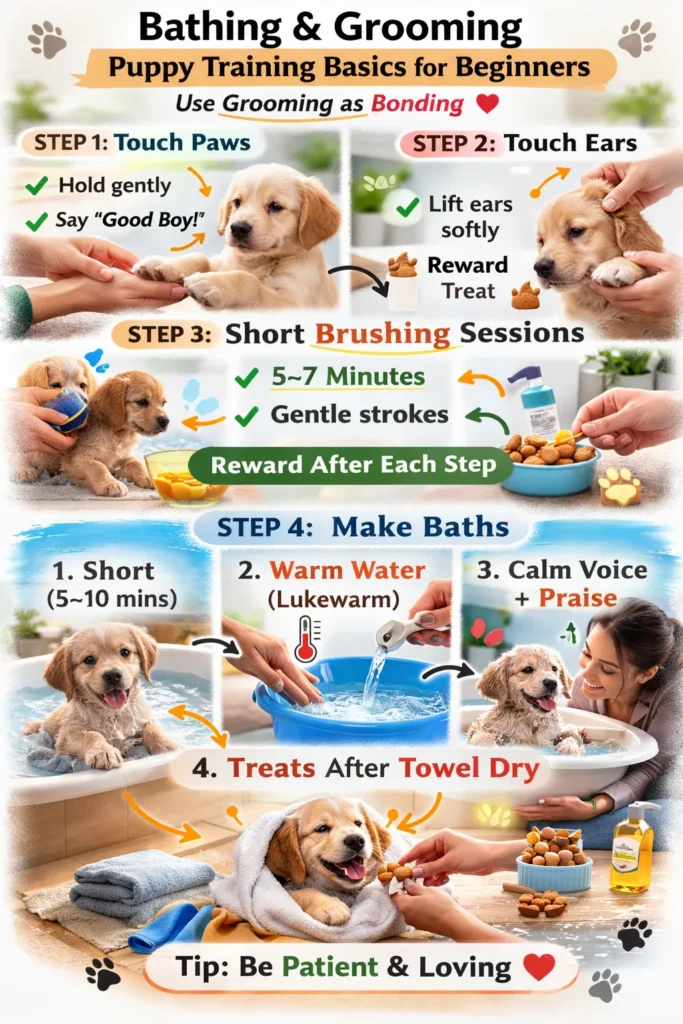
Use grooming as bonding.
Start with:
- Touch paws
- Touch ears
- Short brushing sessions
- Reward after each step
Make baths:
- Short
- Warm water
- Calm voice
- Treats after towel dry
Making the Vet a Happy Place
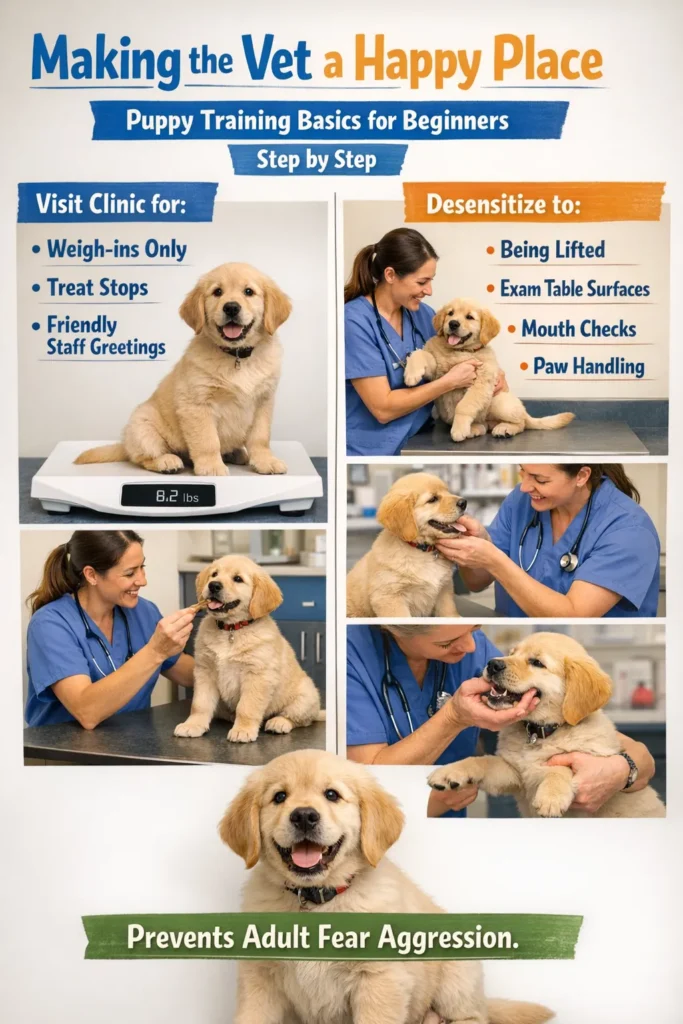
Visit clinic for:
- Weigh-ins only
- Treat stops
- Friendly staff greetings
Desensitize to:
- Being lifted
- Exam table surfaces
- Mouth checks
- Paw handling
Prevents adult fear aggression.
Best Puppy Food (2026 Feeding Guidelines)
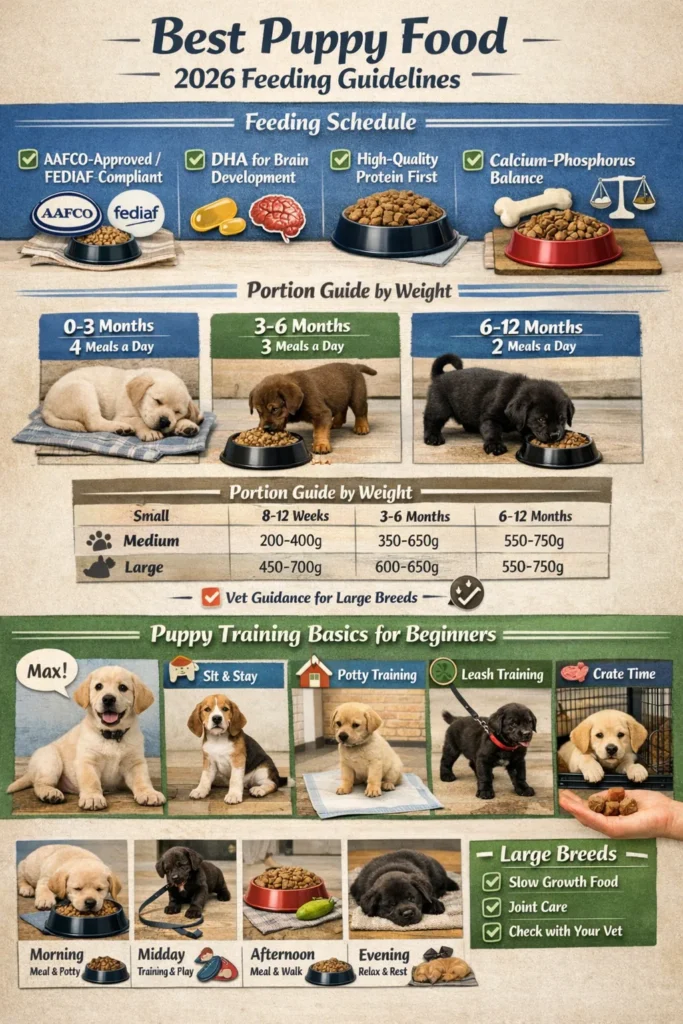
Look for:
- AAFCO-approved formulas (US)
- FEDIAF compliant (UK)
- DHA for brain development
- High-quality protein source first
- Proper calcium-phosphorus balance
Follow:
- Age-specific feeding charts
- Weight-based portions
- Vet guidance for large breeds
High-Value Training Treats
Ideal rewards should be:
- Soft
- Small (pea-sized)
- Low calorie
- Highly palatable
Popular 2026 options:
- Freeze-dried chicken
- Boiled turkey bits
- Soft training chews
- Plain cooked lean beef pieces
Avoid:
- High-fat table scraps
- Sugary treats
- Artificial additives
FAQs
- What are the most important puppy training basics for beginners in 2026?
- The best basics are Potty Training, Crate Training, and Socialization to ensure a well-adjusted adult dog.
- How long does it take to potty train a puppy?
- With a simple, consistent routine, most puppies can be fully trained in 4 to 6 weeks.
- What is the best age to start puppy training basics for beginners?
- You can start easy training as early as 8 weeks old—the moment they arrive home!
- How do I stop my puppy from biting and nipping?
- Use the “Redirection” method—offer a top-rated Cat Toy or Accessory or chew toy whenever they nip.
- Is crate training cruel?
- No, when done correctly with Pet Safety Tips, a crate becomes a “den” that provides security and aids in potty training.
- How often should I train my puppy?
- Short, simple sessions of 5 minutes, 3 to 5 times a day, are best for their short attention spans.
- What should I do if my puppy refuses to walk on a leash?
- Use our Leash Training guide: start indoors with high-value treats to build confidence.
- Can I train my puppy without using treats?
- While treats are the best motivator, you can also use praise and play as a top reward.
- Why does my puppy cry in the crate at night?
- This is normal behavior; ensure the crate is comfortable and try a 2026 “Heartbeat Sheep” toy for comfort.
- How do I socialize my puppy before they are fully vaccinated?
- Carry them in a Pet Carrier to busy areas or have friends visit—this is an easy way to socialize safely.
- What is the “Leave It” command used for?
- It is vital for Pet Safety, preventing your pup from eating dangerous items like Toxic Spring Plants.
- When should I see a professional dog trainer?
- If you encounter aggression or severe anxiety, consulting a Professional Grooming Tip or trainer is the best course of action.
Final Verdict
In fact, the statement about puppy training tops it all in quality; Best Puppy Training Tips for Beginners 2026 As we’ve looked at in this Complete Guide, the difference between a hyper puppy and a well-mannered adult pooch is all about using consistent, patient positive reinforcement techniques as he matures. With a simple daily routine and well-rated Puppy Training Basics, you are not only teaching commands but building trust and securing your dog’s Pet Health & Wellness.
At Petscarex. com, which focuses on helping owners in the US, UK and Canada with practical tips. Our books, from Potty Training Guides to Socialization Tips, aim to make puppyhood as stress free as possible. The early weeks can be overwhelming, do not let this. And stick to your Puppy Care Guide, use the best grooming tools you can find on the market to build handling confidence — even it’s a little vain — and just have fun seeing your pup grow. An obedient puppy is a happy puppy, and a happy puppy makes a 2026!

Leave a Reply