
Traveling with your four-legged best friend can be an adventure — especially if you don’t have a traveling with pets checklist because let’s be real, it could easily spiral into a logistics nightmare. Think of being halfway across the country and discovering that you forgot your dog’s vaccination records or your cat’s specific calming treats. It’s a widespread issue that can leave animals stressed and owners frustrated.
Whether you’re hitting the open road in the US, taking to the skies in the UK or exploring Canada’s wilds, preparation is what separates a vacation from a headache. With the evolution of travel regulations and pet-friendly services in 2026, keeping up with trends is one way to continue enjoying time spent away from home with pets.
This guide is here to make the journey easier. We’ve boiled down years of veterinary advice and expert traveler experience into one all-in-one guide. We’ll detail everything from pre-trip health checks to the exact “must-haves” for your car or cabin. For you, by the end of this article, you can read a tried and true plan that will ensure your four-legged friend is safe, comfortable and welcome wherever in the world they go with you.
In this complete guide, you’ll discover:
- Essential documents needed for US/UK/Canada travel.
- The “Must-Have” packing list for dogs and cats.
- Expert tips for air travel vs. road trips in 2026.
- How to handle pet anxiety on the move.
The Ultimate Traveling with Pets Checklist: A Complete Guide for 2026
Traveling with pets in 2026 requires a high level of preparation, especially with updated airline safety standards and stricter international health regulations. This checklist covers the essential documents, gear, and health steps to ensure a smooth journey.
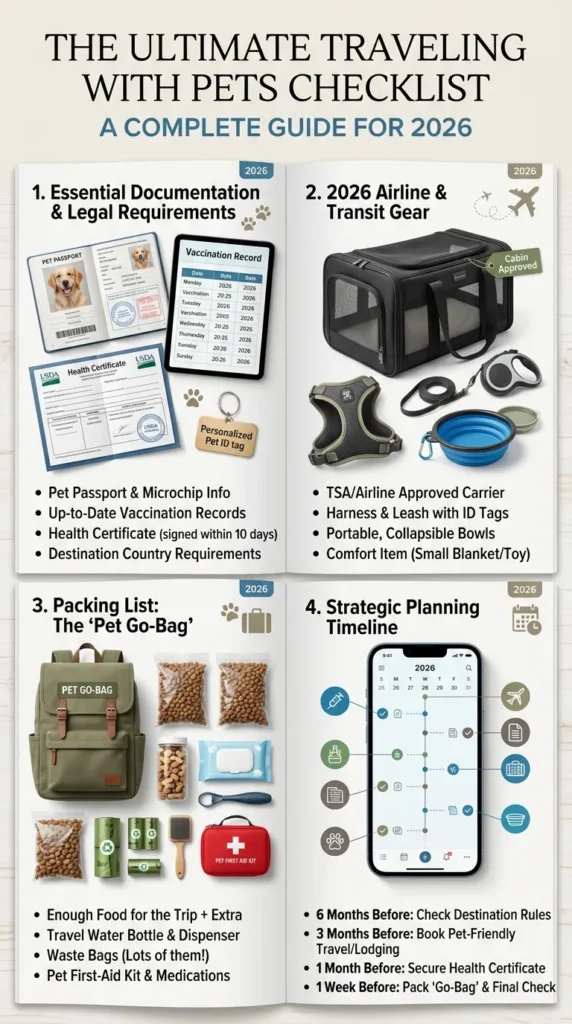
1. Essential Documentation & Legal Requirements
- ISO Compliant Microchip: Your pet must have a 15-digit ISO 11784/11785 microchip implanted. Most important, it has to be implanted before the rabies vaccination for the shot to be recognized as valid by many countries.
- Vaccination Records: Ensure all vaccinations are up to date and recorded in a neat booklet with clear vet stamps. Most places require rabies to be given at least 21–30 days ahead of travel, but no more than 12 months ahead.
- Rabies Titer Test: For “rabies-free” destinations like Japan, Australia, or Hawaii, a blood test (titer) is often required 3–6 months in advance to prove vaccine efficacy.
- Health Certificates:
- Domestic: A “Fit-to-Fly” certificate is typically needed within 24–72 hours of departure.
- International: An official Certificate of Veterinary Inspection (CVI) or EU Pet Passport is generally required, often issued within 10 days of travel.
- Import Permits: Check the official agriculture website of your destination for specific 2026 entry permits.
2. 2026 Airline & Transit Gear
- IATA-Compliant Carrier: By 2026, most airlines require a carrier with ventilation on 3+ sides and metal nuts/bolts (no plastic clips) in addition to space for the pet to stand up and turn around.
- In-Cabin Comfort: If flying in-cabin, use a soft-sided carrier that fits under the seat
- Identification: Attach two forms of ID (tags and microchip) plus a recent printed photo of your pet to the carrier.
- Safety Restraints: For car travel, use a crash-tested Seatbelt Harness or a secured hard-sided crate.
3. Packing List: The “Pet Go-Bag”
- Nutrition: Pack at least 3–5 days of regular food in your carry-on to avoid digestive issues if checked bags are delayed.
- Hydration: Include Collapsible Bowls and a spill-free water bottle.
- Hygiene Kit: Biodegradable waste bags, pet-safe wipes, and absorbent pee pads for the carrier.
- First-Aid Essentials: Gauze, antiseptic spray, tweezers for ticks, and any regular medications.
- Anxiety Relief: A blanket or T-shirt that smells like home can significantly reduce stress in new environments.
4. Strategic Planning Timeline
| Timing | Action Item |
|---|---|
| 6+ Months Out | Research destination import rules; ensure ISO microchip is implanted. |
| 3–4 Months Out | Complete rabies vaccination and any required titer blood tests. |
| 1–2 Months Out | Book flight (many airlines cap pets per flight) and start crate training. |
| 10 Days Out | Final vet check for the official international health certificate. |
| 24 Hours Out | Pack the pet “go-bag” and confirm flight details with the airline’s pet desk. |
Why a Checklist is Non-Negotiable in 2026
By 2026, a pet travel checklist is not optional; world guidelines went from setting rules to enforcing them with strict, zero-tolerance policies. Overlooking any detail here risk your pet being refused boarding or mandatory quarantined — even deported, at your expense.
1.Why 2026 Standards are Stricter
- Zero-Tolerance for Documentation Errors: New regulations starting in 2026, especially in the E.U., prioritize “enforcement consistency,” meaning a small clerical-error — such as an incorrect microchip number or just slightly mistaken date — can stop you from going.
- The “Six-Month Rule”: The old acceptable solutions are now gone, especially in terms of rabies: In most cases, with the exception of countries that never had rabies like New Zealand or UK all dogs must be at least 6 months old to enter a country.
- Carrier Compliance: The airlines are no longer with the “airline approved” marketing. In 2026, many now insist you weigh your pet unceremoniously in the carrier at check-in; if the total exceeds a (often 7–10 kg) limit on them and their cage, they don’t fly cabin.
2.Consequences of Skipping the Checklist
- Denied Boarding: Airlines will not allow a pet on the plane without a health certificate issued within a precise window (typically within 10 days of travel).
- Mandatory Quarantine: If entry requirements are not satisfied at the time of arrival (such as missing rabies titer test results), pets can be sent into quarantine — for weeks or months.
- Financial Penalties: Last-minute vet visits, flight rebookings, or emergency boarding fees can add hundreds to thousands of dollars to your trip costs.
- Health Hazards: Checklists ensure precautions are taken, such as never sedating your pet (at high altitudes, it can be life-threatening) and making sure your pet isn’t a brachycephalic breed that could be declined entry into cargo holds because of respiratory risks.
3.Essential 2026 Checkpoints
- ISO Microchip First: The microchip must be implanted before the rabies vaccine for the documentation to be valid.
- Government Endorsements: Many international routes now require an official government “stamp” (like the USDA APHIS endorsement) in addition to your local vet’s signature.
- “Fit-to-Fly” Timing: Most airlines require a wellness check and certificate no older than 24–72 hours for domestic or 10 days for international flights
Pre-Trip Preparation (The 1-Month Mark)
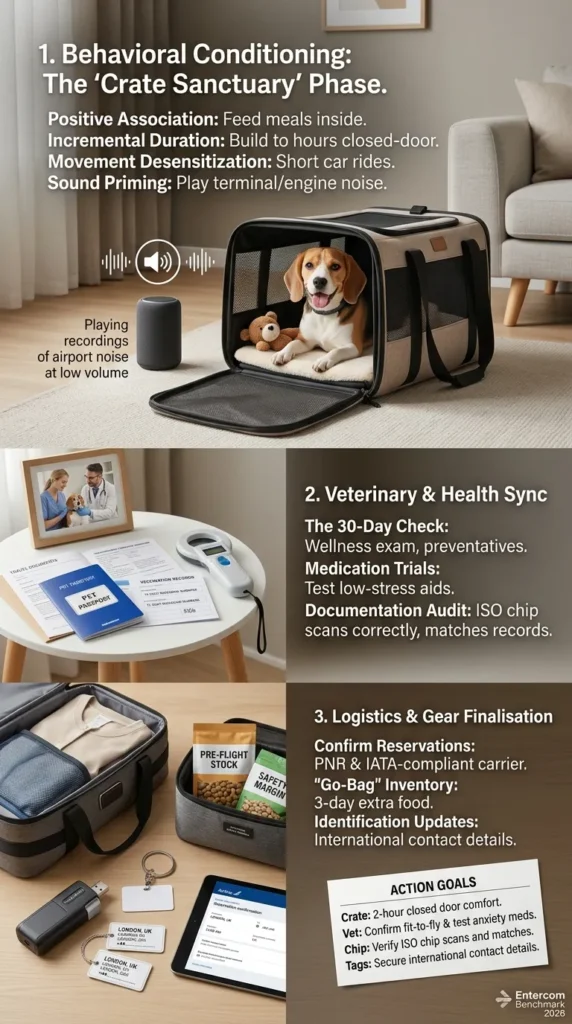
Entercom Benchmark It also measures willingness to cooperate — Collaboration is only scored from the one-month mark as preparation moves from research by administration into behavioral conditioning/active conjunction and finally synchronizing health. In 2026, this phase is crucial to help your pet adjust physically and mentally for the zero-tolerance enforcement that will be in place at borders and airports.
1. Behavioral Conditioning: The “Crate Sanctuary” Phase
By now, your pet’s carrier should no longer be a storage item but a permanent, inviting part of your living space.
- Positive Association: Feed all daily meals inside the carrier to build a “food = safety” connection.
- Incremental Duration: Gradually increase the time the door remains closed—start with 2 minutes post-meal and work up to several hours to simulate flight length.
- Movement Desensitization: Once they are calm in the crate try picking it up and gently carrying it around the house, followed by short 10–15-minute car journeys to help them get used to movement in a vehicle and engine noise.
- Sound Priming: During playtime, set up some speakers and have them play recordings of airport terminal noise (low volume) or jet engines to help reduce “sensory overload” on travel day.
2. Veterinary & Health Sync
- The 30-Day Check: Book a wellness exam to make sure your pet is “fit-to-fly.” Now is the time to update routine preventatives for fleas, ticks, and heartworm in many regions — often required for entry into many areas in 2026.
- Medication Trials: If your pet is prone to high anxiety, talk to your vet now about low-stress pharmaceutical aids. Most importantly, try these at home at least twice this month to look for adverse reactions before they’re at 30,000 feet.
- Documentation Audit: Ensure that your pet’s ISO-compliant microchip scans correctly at the clinic. Make sure the 15-digit number exactly matches your vaccine records.
3. Logistics & Gear Finalisation
- Confirm Airline Reservations: In 2026, most airlines limit the number of pets allowed per flight. Re-confirm your pet’s PNR (Passenger Name Record) reservation and verify that your specific carrier model still adheres to the most current IATA-compliant regulations.
- “Go-Bag” Inventory: Begin sourcing your pet’s regular food The global pet food landscape takes time to adapt to, with some areas implementing stricter controls on imported meat-based pet food in 2026; ensure you pack enough for the journey with a three-day safety margin to account for delays.
- Identification Updates: Order temporary ID tags that include your destination address and a phone number with the international country code.
| Action | Goal |
|---|---|
| Crate Training | Reach a 2-hour “closed door” comfort level. |
| Vet Visit | Confirm “fit-to-fly” status and test anxiety meds. |
| Chip Check | Verify the ISO chip scans and matches all paperwork. |
| ID Tags | Secure tags with international contact details. |
The Essential Packing List (Categorized)
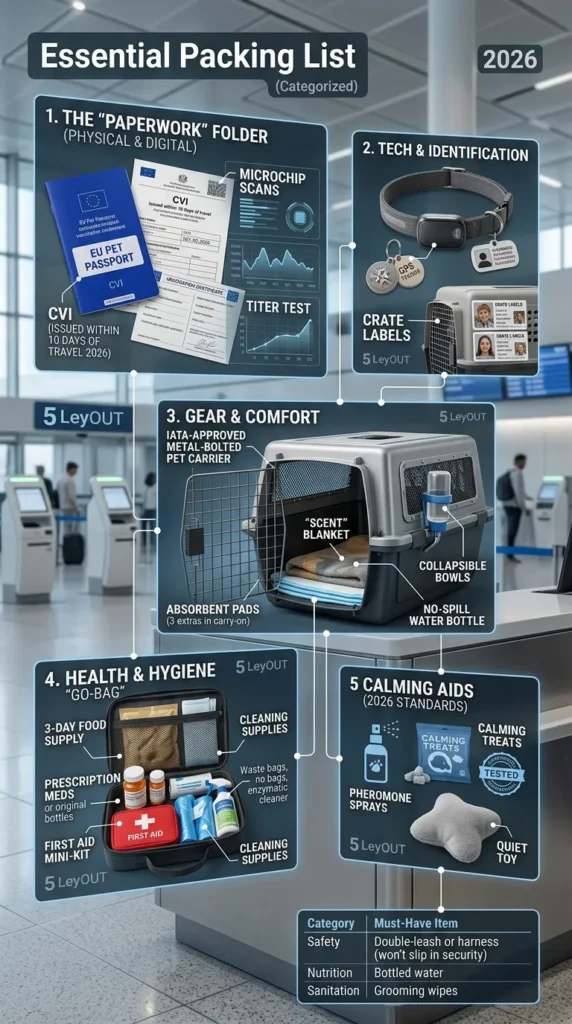
Here’s your master list, categorized to make sure nothing is left at the curb.
1. The “Paperwork” Folder (Physical & Digital)
In 2026, though, adapting your checklist to your particular mode of travel is key because safety requirements and spatial constraints are all very different for aircraft, cars, trains and ships.
- Health Certificate: The original CVI or EU Pet Passport (issued within 10 days of travel).
- Rabies Proof: Vaccination certificate showing the microchip number and date of implantation.
- Titer Test Results: If traveling to rabies-free zones (original lab reports).
- Acclimation Letter: For cargo travel, a vet note stating your pet can withstand specific temperature ranges.
- Emergency Contacts: A list including your home vet, a vet at your destination, and the 24/7 airline pet desk.
2. Tech & Identification
- GPS Tracker: Devices like AirTags or Tractive (attached to the collar, not the crate).
- Dual ID Tags: One tag with your permanent info; a second temporary tag with your destination address and WhatsApp/International phone number.
- Crate Labels: “Live Animal” stickers with your pet’s photo, name, and your contact info taped to the top and side of the carrier.
3. Gear & Comfort
- IATA-Approved Carrier: Ensure it has metal bolts and 3-sided ventilation.
- The “Scent” Blanket: A thin blanket or old T-shirt that smells like home (helps lower cortisol levels).
- Absorbent Pads: Line the carrier with pee pads; pack 3 extras in your carry-on for accidents during layovers.
- Collapsible Bowls: Silicone versions for food and water to save space.
- No-Spill Water Bottle: A clip-on “drip” bottle or a deep-rimmed bowl that attaches to the crate door.
4. Health & Hygiene “Go-Bag”
- 3-Day Food Supply: Pack in your carry-on. If checked luggage is lost, you don’t want to switch brands abruptly (causes stomach upset).
- Prescription Meds: In original bottles with the vet’s prescription label.
- First Aid Mini-Kit: Styptic powder (for torn nails), antiseptic wipes, and tweezers for ticks.
- Cleaning Supplies: Biodegradable waste bags, a small bottle of enzymatic cleaner, and paper towels.
5. Calming Aids (2026 Standards)
- Pheromone Sprays: Spray the carrier 15 minutes before departure (e.g., Feliway for cats, Adaptil for dogs).
- Calming Treats: Only use brands your pet has already tested during your 1-month prep phase.
- Quiet Toys: Avoid squeakers; opt for soft plushies or a durable rubber chew.
| Category | Must-Have Item |
|---|---|
| Safety | Double-leash or a harness that won’t slip during airport security. |
| Nutrition | Bottled water (tap water in new cities can cause diarrhea). |
| Sanitation | Grooming wipes for “airplane smell” after landing. |
Mode of Transport: Customizing Your Checklist
As of 2026, travel health kits now incorporate digital health monitoring in addition to traditional medical supplies. How high-altitude cabin pressure and new regional allergens might affect you, the pet’s first responder.
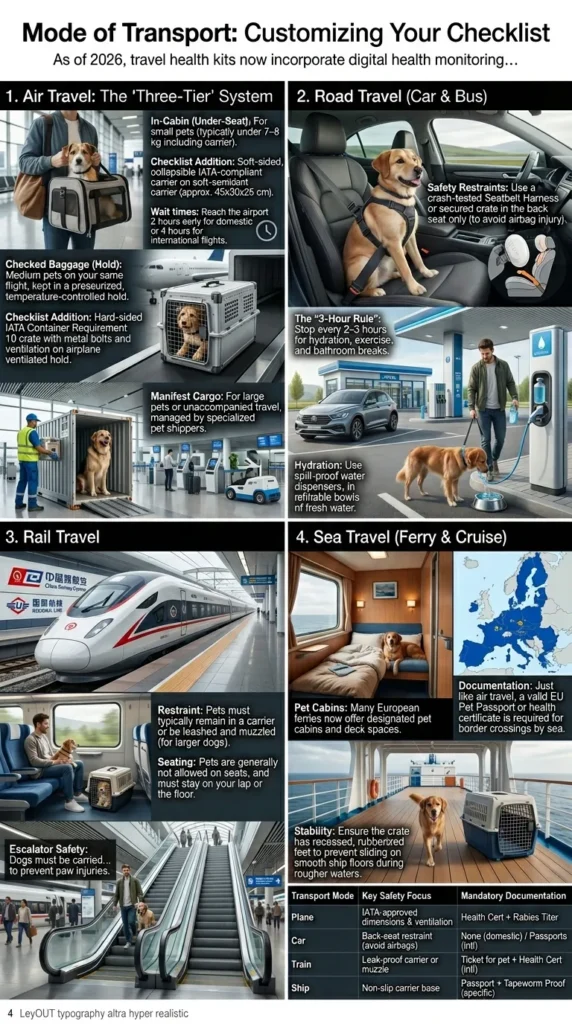
1. Air Travel: The “Three-Tier” System
Airlines now strictly categorize pets based on size and route.
- In-Cabin (Under-Seat): For small pets (typically under 7–8 kg including carrier).
- Checklist Addition: Soft-sided, collapsible IATA-compliant carrier (approx. $45 \times 30 \times 25$ cm).
- Wait times: Reach the airport 2 hours early for domestic or 4 hours for international flights.
- Checked Baggage (Hold): Medium pets on your same flight, kept in a pressurized, temperature-controlled hold.
- Checklist Addition: Hard-sided IATA Container Requirement 10 crate with metal bolts and ventilation on 4 sides for international travel.
- Manifest Cargo: For large pets or unaccompanied travel, managed by specialized pet shippers.
2. Road Travel (Car & Bus)
Focus is on crash-tested security and temperature control. [3, 7]
- Safety Restraints: Use a crash-tested Seatbelt Harness or secured crate in the back seat only (to avoid airbag injury).
- The “3-Hour Rule”: Stop every 2–3 hours for hydration, exercise, and bathroom breaks.
- Hydration: Use spill-proof water dispensers or refillable bowls at every stop.
3. Rail Travel
Regulations in 2026 vary by region, with some networks like China Railway Express and various EU lines offering pet-friendly cabins.
- Restraint: Pets must typically remain in a carrier or be leashed and muzzled (for larger dogs).
- Seating: Pets are generally not allowed on seats and must stay on your lap or the floor.
- Escalator Safety: Dogs must be carried on station escalators to prevent paw injuries.
4. Sea Travel (Ferry & Cruise)
- Pet Cabins: Many European ferries now offer designated pet cabins and deck spaces.
- Documentation: Just like air travel, a valid EU Pet Passport or health certificate is required for border crossings by sea.
- Stability: Ensure the crate has recessed, rubberized feet to prevent sliding on smooth ship floors during rougher waters.
| Transport Mode | Key Safety Focus | Mandatory Documentation |
|---|---|---|
| Plane | IATA-approved dimensions & ventilation | Health Cert + Rabies Titer |
| Car | Back-seat restraint (avoid airbags) | None (domestic) / Passports (intl) |
| Train | Leak-proof carrier or muzzle | Ticket for pet + Health Cert (intl) |
| Ship | Non-slip carrier base | Passport + Tapeworm Proof (specific) |
Health & First Aid Essentials
In 2026, travel health kits have evolved to include both digital health tracking and traditional medical supplies. Whether you are dealing with high-altitude cabin pressure or new regional allergens, being your pet’s first responder is vital.
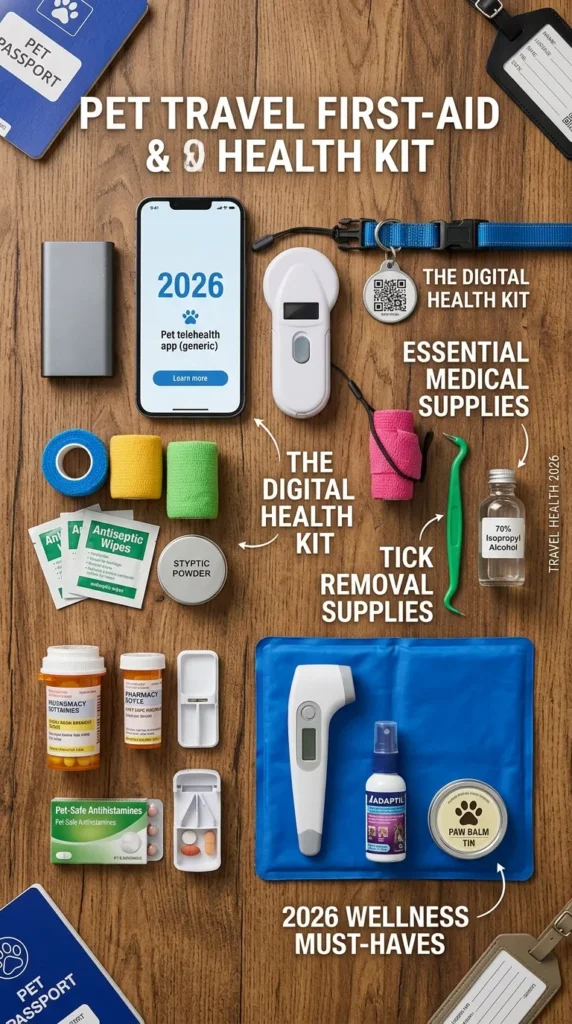
1. The Digital Health Kit
- Digital Medical Records: Store a PDF of all vaccinations and recent bloodwork on your phone and a cloud drive.
- Telehealth App: Pre-load a veterinary telehealth app (like Pawp or Airvet) that offers 24/7 consultations in your destination’s language.
- Microchip Verification: A screenshot of your pet’s registration in a global database (like HomeAgain or PetLink).
2. Essential Medical Supplies
- Wound Care: Self-adhesive bandages (that don’t stick to fur), antiseptic wipes, and Styptic powder to stop bleeding from torn nails.
- Digestive support: Bring along a three-day supply of probiotic paste (such as Forti Flora) and bland diet toppers to fight “travel tummy” from stress or new water sources.
- Allergy Relief: Ask your vet for the correct dosage of pet-safe antihistamines for your specific pet’s weight.
- Tick & Parasite Tools: A dedicated tick removal tool and a small bottle of 70% isopropyl alcohol for disinfection.
3. Medication Management
- Original Packaging: All prescriptions must remain in their original pharmacy bottles with the label matching your ID.
- Travel Sickness/Anxiety: If using meds like Cerenia (for motion sickness) or Gabapentin (for anxiety), ensure you have enough for the return journey plus a 2-day buffer.
- Pill Splitter/Pockets: Useful for administering meds in high-stress environments like a cramped airplane cabin or a busy train station.
4. 2026 Wellness “Must-Haves”
- Paw Balm: Critical for protecting pads against hot tarmac in summer or salted sidewalks in winter.
- Collapsible Cooling Mat: For brachycephalic (flat-faced) breeds, these are life-saving during long layovers in non-air-conditioned terminals.
- Calming Pheromones: A travel-sized Adaptil (dogs) or Feliway (cats) spray to apply to the carrier 15 minutes before departure.
| Item | Purpose |
|---|---|
| Saline Solution | Flushing eyes/ears of dust or debris. |
| Muzzle | Essential for emergency treatment (even friendly pets may bite when in pain). |
| Digital Thermometer | Monitoring for heatstroke (normal pet temp is 38–39.2°C). |
Destination Management
In 2026, destination management extends beyond a three-second online query for “pet-friendly” hotels to traversing an intensely bureaucratic global grid of pet infrastructure and zero-tolerance entry enforcement.
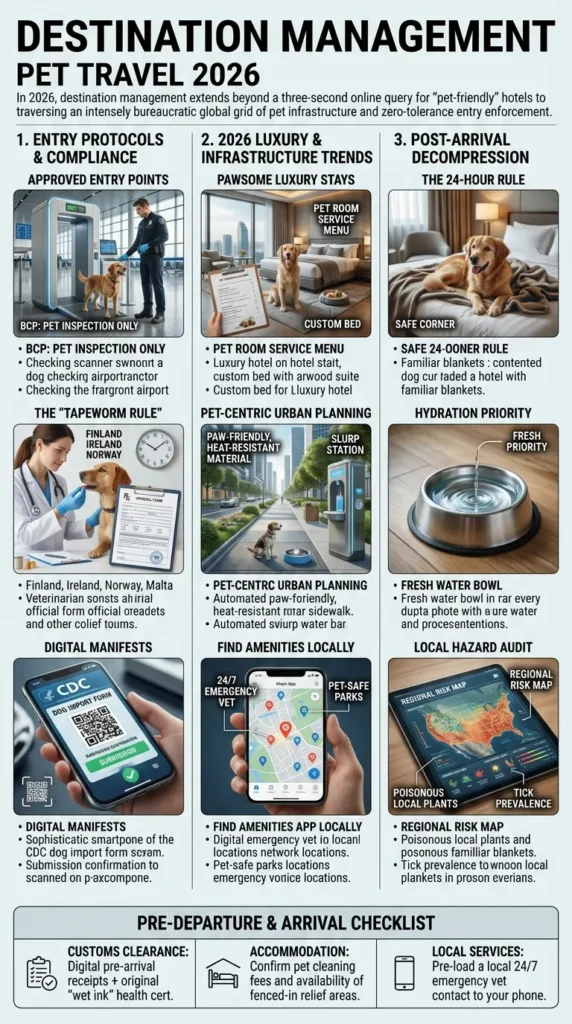
1. Entry Protocols & Compliance
Arrival is the most critical phase where minor errors can trigger mandatory quarantine or deportation.
- Approved Entry Points: Many countries now mandate entry through specific Border Control Posts (BCPs) equipped to inspect animals. Confirm your arrival airport is an authorized pet entry point.
- The “Tapeworm Rule”: Destinations like Finland, Ireland, Norway, and Malta require documented tapeworm treatment administered exactly 24–120 hours before arrival.
- Digital Manifests: In 2026, many regions (like the U.S. via the CDC Dog Import Form) require digital pre-arrival submissions to be shown on your phone upon landing.
2. 2026 Luxury & Infrastructure Trends
The “Pawprint Economy” has transformed how hotels and cities accommodate pets. [9]
- Pawsome Luxury Stays: Top-tier brands like Hilton and Preferred Hotels & Resorts now offer dedicated pet menus, custom beds, and in-house professional grooming or veterinary services.
- Pet-Centric Urban Planning: Major cities are debuting “walking paths” with paw-friendly, heat-resistant materials and dedicated “slurp stations” (automated water bars).
- Find Amenities Locally: Use verified 2026 resources like BringFido for hotels or local expat groups to identify nearby 24/7 emergency clinics and pet-safe parks.
3. Post-Arrival Decompression
- The 24-Hour Rule: Dedicate the first full day to acclimation. Set up a “safe corner” immediately with familiar-smelling bedding and toys to lower cortisol.
- Hydration Priority: Offer water immediately but keep meals light for the first 12 hours to avoid stomach upset from travel stress.
- Local Hazard Audit: Research regional risks such as poisonous local plants, tick prevalence, or specific toxins (like certain slug pellets) used in city parks.
| Destination Focus | Requirement |
|---|---|
| Customs Clearance | Digital pre-arrival receipts + original “wet ink” health cert. |
| Accommodation | Confirm pet cleaning fees and availability of fenced-in relief areas. |
| Local Services | Pre-load a local 24/7 emergency vet contact to your phone. |
FAQs
- What is the most important item on a traveling with pets checklist? Identification and health records are the highest priority.
- Can I fly with my dog in the cabin in 2026? Yes, but most airlines have weight limits (usually under 20 lbs) and require specific carriers.
- How do I prepare my cat for a long road trip? Start with short car rides and use pheromone sprays like Feliway in their carrier.
- Do I need a passport for my pet in the UK? The UK uses the Animal Health Certificate (AHC) for pets coming from the EU; check specific 2026 updates for US travelers.
- How often should I stop for my dog on a road trip? Every 2-3 hours for bathroom breaks and stretching.
- What should be in a pet first aid kit for travel? Gauze, antiseptic wipes, tweezers, and a copy of medical records.
- Is it safe to sedate my pet for flying? Most vets recommend against sedation as it affects breathing at high altitudes; use calming supplements instead.
- What are the best pet-friendly hotel chains in the US? Kimpton, Aloft, and Motel 6 are known for being highly accommodating.
- Do microchips work internationally? Most modern chips (ISO 11784/11785) are readable globally.
- How do I keep my pet cool in the car? Use sunshades and never leave them alone; 2026 smart-collars can now alert your phone if temperatures rise.
- What food should I pack? Stick to their regular diet; travel is not the time to try new treats.
- How do I find a vet while traveling? Use apps like “Vet24” or Google Maps to locate the nearest emergency 24-hour clinic.
Final Verdict
Traveling the world with your pet is one of life’s greatest pleasures, but it requires careful preparation. As we leave 2026 behind, travel standards are elevated and being “pretty sure” that you packed all the necessary items won’t cut it. With this traveling with pet checklist, you aren’t just packing a bag; you’re making sure to keep a member of your family safe and comfortable.
Ahn, whose heavenly-like feet have kept him engaged with both physical and financially sustainable travel, knows that the love is half of the journey. Every detail counts, from getting the official international paperwork to packing that one “squeaky toy” they can’t live without. Keep in m




Leave a Reply